No Results Found
The page you requested could not be found. Try refining your search, or use the navigation above to locate the post.
We often find ourselves disagreeing with Rebel News — but isn’t that what democracy is about?
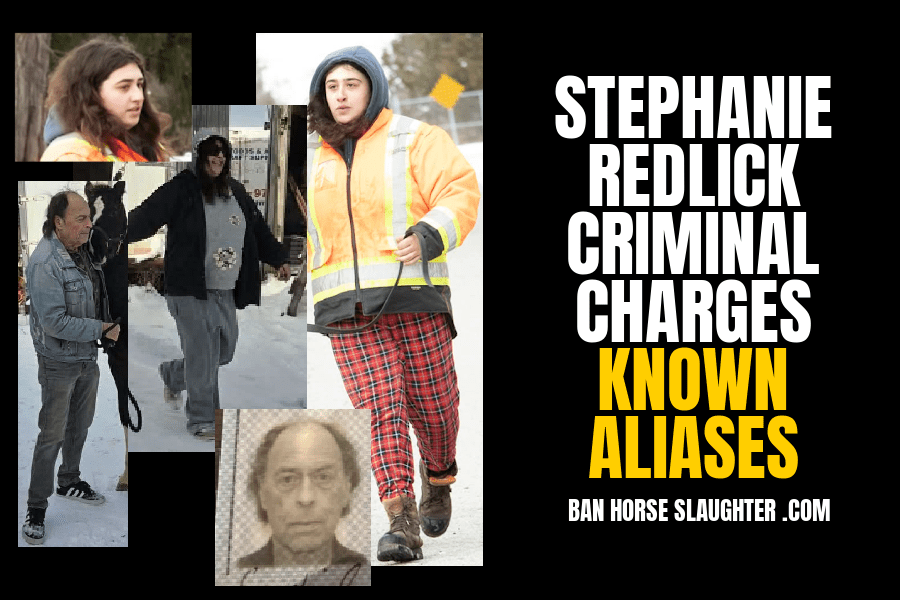
We don’t have to agree on politics to find common ground on accountability, transparency, and protecting animals. For that reason, we are extremely grateful for the investigative work they devoted to exposing Stephanie Redlick’s 13 animal welfare charges and two sets of criminal charges.
Their recent feature, led by reporter David Menzies, presents documentation and firsthand encounters that deserve public attention.
P.S. We are hard pressed (like David Menzies) to find one statement Redlick makes that is true. But don’t take our word for it, see the documentation below.
The page you requested could not be found. Try refining your search, or use the navigation above to locate the post.
Every year, thousands of horses in Canada are flown overseas for slaughter — including to Japan. The way in which they are transported in no way resembes how show, race or other sport horses are shipped.
These long-haul flights are legally permitted to last up to 28 hours, but evidence shows that this limit is often exceeded.
Horses — large draft breeds — are crammed into wooden shipping crates with no access to food, water, or veterinary care for the duration of transport.
Documented cases show horses arriving injured, collapsing on landing, or dying en route.
In 2023, Liberal MP Tim Louis introduced Bill C-355 to ban the live export of horses from Canada for the purpose of slaughter.
The bill passed the House of Commons with the support of every Liberal, New Democratic Party, and Green Party Member of Parliament, and without the support of a single Conservative or Bloc Québécois MP.
Despite passing Parliament, the bill stalled in the Senate and ultimately died when the federal election was called in April 2025.
During Senate consideration, repeated procedural delays — including those led by Senator Rob Black — were used to run out the clock on the bill.
As a result, the barbaric live export of horses from Canada for slaughter continues today.
We are grateful to Senator Pierre Dalphond for championing Bill C-355 in the Senate. His dedication to protecting horses in Canada is deeply appreciated — and we urge Senator Dalphond to reintroduce similar legislation.
Horses are also slaughtered domestically in Canada — including pets, workhorses, racehorses, rodeo horses, sport horses, and horses imported from the United States.
Unlike traditional food animals, horses in Canada and the United States are routinely treated throughout their lives with medications such as phenylbutazone (“bute”), dewormers, and other drugs that are toxic to humans and explicitly prohibited from the human food chain.
These toxic to humans substances are commonly administered without any lifetime tracking system or withdrawal framework suitable for food safety.
And despite less than 1 percent of horse carcasses being tested in Canada for toxic drugs — recalls of horsemeat occur.
A study funded by the Canadian Food Inspection Agency (CFIA) and conducted at the University of Guelph found that horse meat has entered the Canadian food supply mislabeled as other meats — and the CFIA stated it was not surprised by the findings.
With food prices and cost-of-living pressures rising, it is difficult to believe that food fraud will disappear without stronger oversight and an end to horse slaughter altogether.
Whether exported alive or slaughtered domestically, horses are being forced into a system that was never designed to protect their welfare or public health.
With your support, we can push for legislation that bans both the live export of horses for the purpose of slaughter and the domestic slaughter of horses in Canada.
By signing your name to the following ready-to-send email, you are helping send a clear message: it’s time to end this cruelty — and the risks that come with it — for good.
This is a done-for-you email that makes it easy to contact the decision-makers who can end horse slaughter in Canada.
Step-by-Step
1. Enter your name and postal code
Your postal code is used only to identify your local Member of Parliament so your message goes to the right office.
2. Click “Generate message”
A pre-written email appears in whatever email program or APP you usually use. You can send it as-is or personalize it if you wish.
3. Click “Open email to send”
Your own email program opens with the message addressed to:
the Minister of Agriculture
the Opposition Agriculture Critic
Senator Pierre Dalphond
your local MP
Your Privacy
Your email is sent from your own email account
Your personal information is not stored
Ban Horse Slaughter does NOT sell your data
Subject: Ban the Live Export of Horses for Slaughter and End Horse Slaughter in Canada
Dear Prime Minister Mark Carney, Minister Heath MacDonald, and Senator Pierre Dalphond,
I am writing as a concerned Canadian to urge your support for legislation to end horse slaughter in Canada — both the live export of horses for the purpose of slaughter and domestic horse slaughter within Canada.
In 2023, Bill C-355, introduced by MP Tim Louis, passed the House of Commons with the support of Liberal, New Democratic Party, and Green Members of Parliament. However, the bill stalled in the Senate and died when the federal election was called in April 2025. As a result, the live export of horses from Canada for slaughter continues today.
I thank Senator Dalphond for his leadership on this issue and respectfully urge the reintroduction and full government support of legislation to finally end this practice.
Horses slaughtered in Canada — including companion, sport, and working horses, as well as horses imported from the United States — are not raised or regulated as food animals.
Throughout their lives they are commonly treated with medications prohibited from the human food chain, creating ongoing animal welfare and food safety concerns.
A study funded by the Canadian Food Inspection Agency and conducted at the University of Guelph found horse meat entering the Canadian food supply mislabeled as other meats. Whether exported alive or slaughtered domestically, horses are being placed into a system never designed to protect their welfare or public health.
I respectfully ask you to support legislation that bans the live export of horses for slaughter and ends domestic horse slaughter in Canada.
Thank you for your consideration.
Sincerely,
[Full Name]
[Street Address]
[City, Province]
[Postal Code]
[Phone Number]
Prime Minister of Canada
📌 Office of the Prime Minister
📧 Email: mark.carney@parl.gc.ca
———-
Minister of Agriculture and Agri-Food (Canada)
📌 Minister of Agriculture and Agri-Food
📧 Email: aafc.minister-ministre.aac@agr.gc.ca
ℹ️ Responsible for federal policy related to livestock transport, slaughter regulations, and food safety oversight.
———-
Opposition Critic for Agriculture and Agri-Food
📌 John Barlow, MP
Shadow Minister for Agriculture and Agri-Food
📧 Email: John.Barlow@parl.gc.ca
ℹ️ Holds the government accountable on agriculture and food policy.
———-
Senator
📌 Senator Pierre Dalphond
📧 Email: PierreJ.Dalphond@sen.parl.gc.ca
ℹ️ Former sponsor of the Horse Protection Act and a key Senate advocate for ending live horse export for slaughter.
———-
Senator
📌 Senator Charles Adler:
📧 Charles.Adler@sen.parl.gc.ca
———-
Your Local Member of Parliament
📌 Your MP (based on your postal code)
📧 Email: Automatically added by the system
ℹ️ Your MP represents you directly in the House of Commons and will receive the same message.
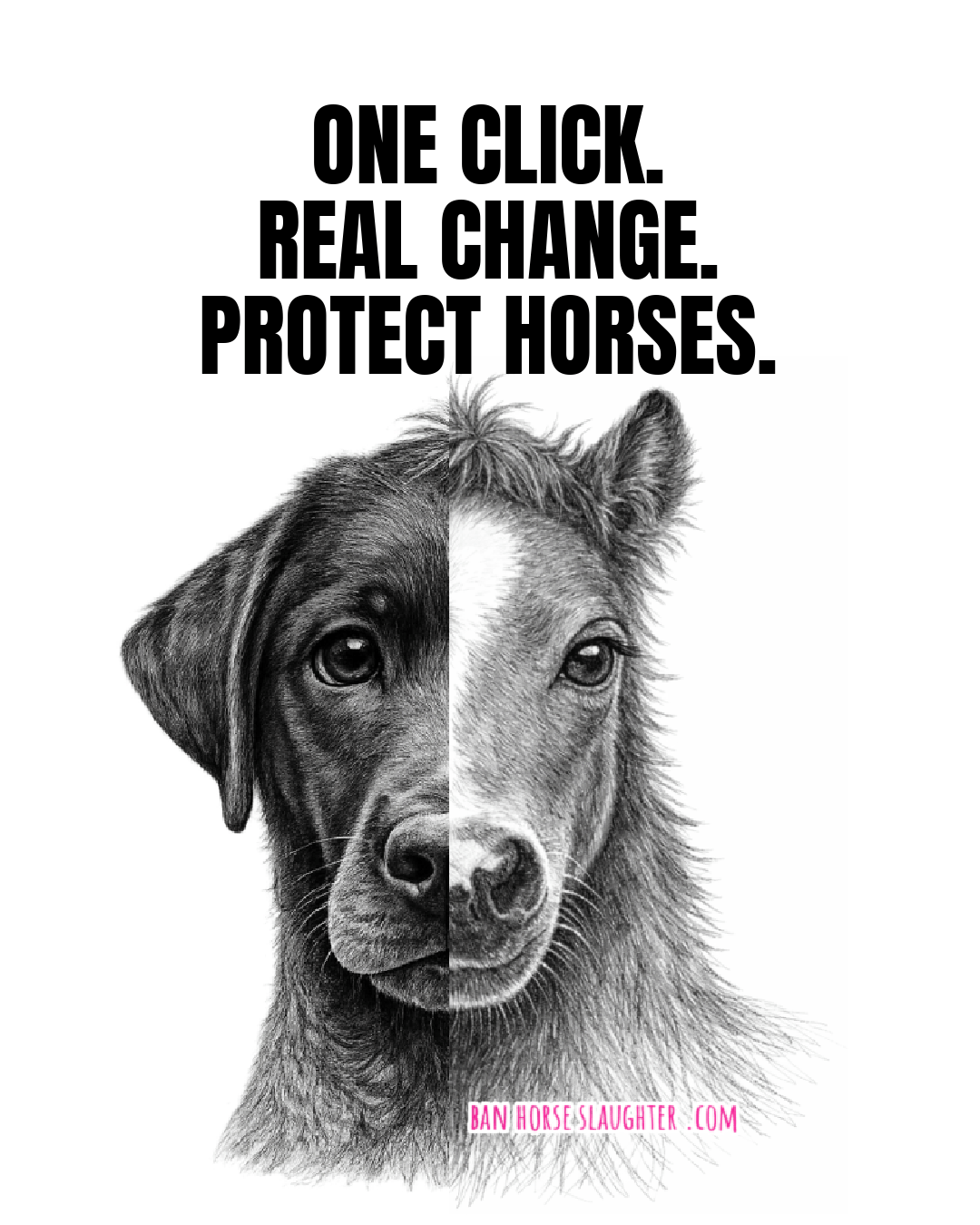
Canadians are horrified to see some countries eat dogs & cats yet in Canada a largely unknown, barbaric business exists.
It takes 2 minutes to speak out ==> https://t.co/G2lV9SgZDd <==@jannarden @marie_bennett #banhorseslaughter #horseshit #chdc @melissagrelo pic.twitter.com/HV2i6pKVhC
— Ban Horse Slaughter (@HorseSlaughter_) March 1, 2026
HAVE YOUR SEEN THIS HORSE?Cassidy Connors, a 21-year-old horse owner, is urgently searching for her gelding, Journey -- a deeply loved companion known for his gentle, friendly nature. Journey is an 8-year-old bay gelding (approx. 15.3 hands). Brown coat, black mane...
IF THIS ISN'T ENOUGH FOR POLICE TO ACT - WHAT IS? You are likely on this blog post because you have seen the video circulating on social media showing a dog being beaten and in clear distress. Two witnesses have since come forward to say the violence began before...
Every year thousands of horses are routinely slaughtered in Canada, for human consumption, but you can help us ban horse slaughter in Canada and beyond.
Some of the meat is consumed in Canada, and much of it is shipped to the European Union, and other markets, including Japan.
This barbaric practice is currently not legal in the United States, so horses from the United States are shipped to Canada, and to Mexico, to be slaughtered.
In addition Canada allows for the transportation of live horses to Japan to be slaughtered for human consumption, and unfortunately the transportation of horses destined for slaughter within Canada, and by air to Japan for slaughter, is far from humane.
LEARN MORE HERE <==
We are 100% volunteer & crowdfunded.
0% goes towards salaries. Yes, ZERO.
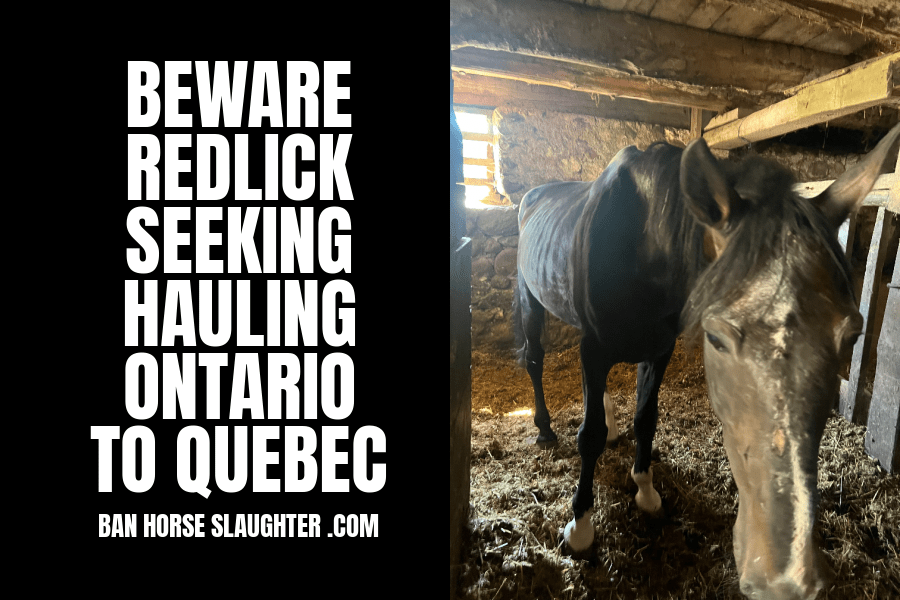
UPDATED JANUARY 2026: Right now, Stephanie Redlick is most often using the name Stephanie Alessia. Her father Sammy Redlick is also operating under the alias Sammy Zee. These are just a few of the over 30 names you are most likely to hear if she contacts you.
In early December, two horses connected to Redlick were moved to a barn in Woodstock, Ontario. The cheque she provided for rent bounced.
As a result, she will be looking for another place for at least two horses in January 2026 — likely cheap, outdoor, or “just a field”-type situations.
Another individual, Mathew Crowe, has been known to act on her behalf. In the past, he has been involved in acquiring horses for her.
Despite the bounced cheque,
two sets of multiple criminal charges (here and here) for theft and fraud,
ongoing, regular criminal court appearances and
16 horses seized by Animal Welfare Services for neglect
and resulting charges –
PLUS an outstanding bill for their care of over $100K
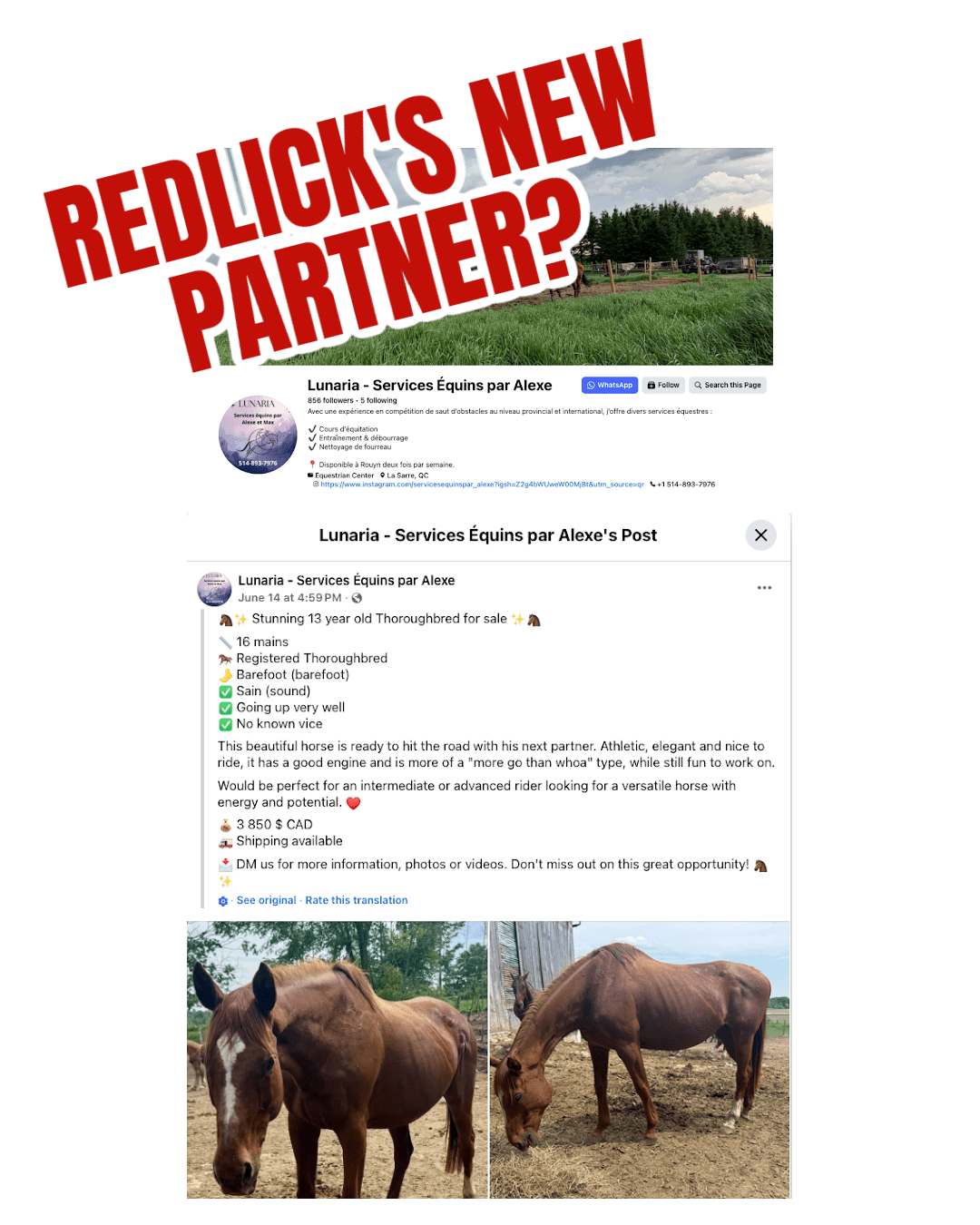
Redlick continues to run multiple, overlapping schemes — including
claiming to be an equine therapist,
offering boarding at a barn that is not in the location she lists – where she has NOT paid rent,
advertising hay for sale that she miraculously claims to have suddenly grown,
offering horse transport with equipment that doesn’t belong to her
and even selling horses she doesn’t own (or never has).
Stephanie Redlick is also actively looking for free horses, claiming to run a rescue (a known scam with no location) and to provide “forever homes.”
She has been calling boarding barns and knocking on doors in rural and semi-rural areas, saying all she needs is a field.
She is not targeting one specific area. In November alone, two property owners narrowly avoided dealing with her — one in Flamborough, the other in Cameron, Ontario.
Horses owned by the Redlicks have previously been in
Oro-Medonte, Port Perry (she didn’t pay),
Flamborough (November) (immediately asked to leave)
Shelburne (November) (again, she didn’t pay),
and most recently Woodstock (December) (You guessed it – the cheque bounced).
Believe it or not, not everyone in the equine world knows about her yet — which is why this matters.
If you’re not familiar with the fact that Animal Welfare Services seized 16 horses from Stephanie Redlick, or that she is currently facing multiple criminal charges, you can learn more here.
Below is a list of known aliases and phone numbers currently and previously used.
Please share this — especially with friends and family who own rural or semi-rural property in Ontario.
Stephanie Redlick hides behind numerous aliases, operating over 30 Facebook accounts and multiple Kijiji profiles under fake names.
Even though Redlick is facing criminal and animal welfare charges she's not stopped creating new profiles to attempt to publicly discredit anyone speaking out against her.
Sammy Redlick (December 2025)
Sparkle Fairy Cleaning Company
Silver Spur Stables (March 2026)
Larkin Roy
Ontarios Shadiest Horse Dealers (NOTE: the missing apostrophe before the s in Ontarios.)
J Martin on Kijiji
OOPS changed almost instantly on Kijiji to Bauman
(Thank you to all who are watching & reporting!)
JOHN HOWARD - MARCH 2026
Sammy Zee (December 2025)
Stephanie Okay
Professional Equine Sales @ gmail. com (Nov. 2025/March 2026)
SS Racing
Bella Mia Thoroughbreds
Stephanie Alessiia
Tyler Bowen (Sept. 2025)
Stephanie Stephanie
Stephanie Kauffman
stephalessiaxo on SnapChat
Precision Stables
King Horse Transport & Hire
King Livestock Transportation
King Farms
Circle R Livestock
Sammy Srz/Sammy Szn (her father)
Mathew Crowe has purchased horses for Redlick.
Anna Koch
Silverbrook Farms
Ashley Watson
Silverbrook Meadows Stables
Simcoe Kennel Club
Rose Barton
Stephanie Schwartz
Alicia Bloomberg
Summer Alessia
S & L Cleaning Services
SBR Breeding & Equine Sales, LTD.
Janice Wilson
Serena @serena10457
Julie Hyde
Jane Smith
Madison O'Donald
Naomi Reid
Aless Stephanie
Alessia King
Above the Stars Equine Rescue (SCAM)
Under the Stars Equine Rescue
Stephanie Quickfall
HorseSales.com
Stephanie Schwartz
Doug Almira
Silverbrook Meadows
Carl Dickson
Jeff Lawson
Rainbow Bridge Stock Removal
Healthy Equine Homeopathy
Healthy Horse Homeopathy
Stephanie Redlick has more than a few phone numbers including:
(226) 988-2005 | (647) 220-3691 | (437) 600-7158 | (647) 695-3057 | (705) 998-7705 | (613) 263-0641 | (647) 797-0289 | (705) 315-0588 | (316) 746-8529 | (647) 474-4071 | (705) 535-0525 | (705) 300-0340 | (226) 988-6961 | * (416) 885-9422 | (226) 988-2005 | (705) 370-6661 | (647) 365-1265 | (705) 995-3697 | (778) 400-0408 | (905) 334-8077 | (416) 507-6450 | Douglas: (647) 462-7004 | (705) 809-0249
That's a GREAT question and one that the Royal Canadian Mounted Police (RCMP) in British Columbia answered after it was reported to them that someone bought a horse from Redlick - that she promised to deliver and $10K later the horse was not delivered.
Later it was discovered that Redlick NEVER had the horse she "sold" in her possession - that the pictures she used were ones she simply found on the Internet.
The RCMP recognized where all the phone numbers came from - "A known service to be widely used by 'professional' scam artists". VERY cheap to secure phone numbers.
It is of course free to set up multiple Facebook profiles and multiple profiles on Kijiji, etc.
And Gmail email address are cheap and easy to set up - she has even more email addresses than phone numbers and fake names.
Many people have stayed silent out of fear—because anyone who speaks out about Redlick's behaviour becomes a target.
Stephanie Redlick's default tactic is to aggressively smear and discredit anyone who dares to expose the truth which only makes us more determined to raise awareness and demand accountability from Ontario’s Animal Welfare Services.
This 2-click "done for you" email sends a clear message to elected officials that Ontarians will not accept a system that allows repeat harm.
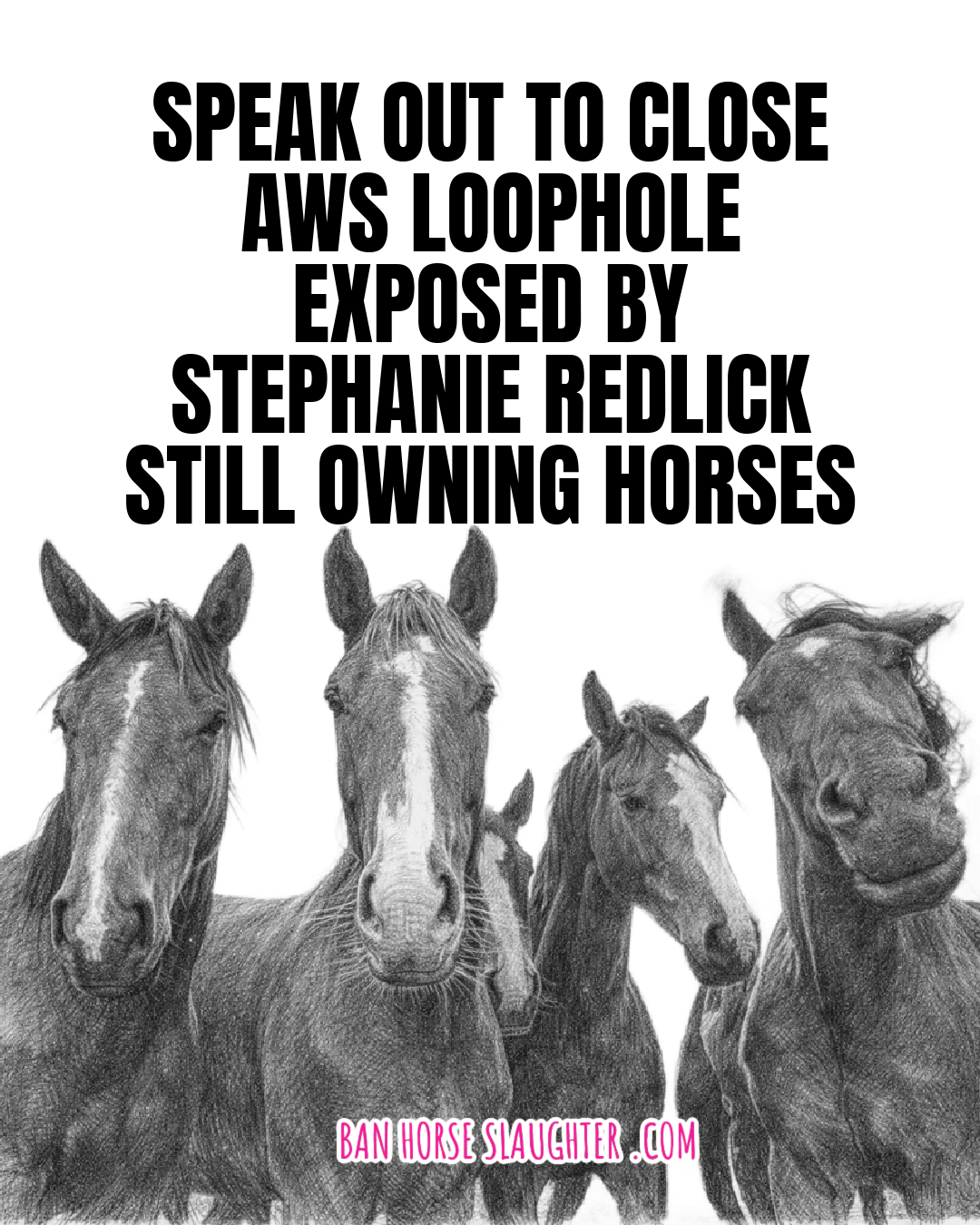
It takes less than a minute — and it puts real pressure on decision-makers to close the loophole that allows Redlick to keep accumulating horses - even after 16 were seized, 13 animal welfare charges were laid - and she owes over $116,000 for their care.
HAVE YOUR SEEN THIS HORSE?Cassidy Connors, a 21-year-old horse owner, is urgently searching for her gelding, Journey -- a deeply loved companion known for his gentle, friendly nature. Journey is an 8-year-old bay gelding (approx. 15.3 hands). Brown coat, black mane...
IF THIS ISN'T ENOUGH FOR POLICE TO ACT - WHAT IS? You are likely on this blog post because you have seen the video circulating on social media showing a dog being beaten and in clear distress. Two witnesses have since come forward to say the violence began before...
Every year thousands of horses are routinely slaughtered in Canada, for human consumption, but you can help us ban horse slaughter in Canada and beyond.
Some of the meat is consumed in Canada, and much of it is shipped to the European Union, and other markets, including Japan.
This barbaric practice is currently not legal in the United States, so horses from the United States are shipped to Canada, and to Mexico, to be slaughtered.
In addition Canada allows for the transportation of live horses to Japan to be slaughtered for human consumption, and unfortunately the transportation of horses destined for slaughter within Canada, and by air to Japan for slaughter, is far from humane.
LEARN MORE HERE <==
We are 100% volunteer & crowdfunded.
0% goes towards salaries. Yes, ZERO.
Updated 2026 | Originally published October 2016
We wish this wasn’t necessary to say — but as long as horse slaughter exists in Canada, every missing horse must be treated as an emergency.
Even if you’re not sure your horse has been stolen… you need to act immediately.
Before anything ever happens, take a few minutes and make sure you have clear, up-to-date photos of your horse.
At minimum, you should have:
– Left side
– Right side
– Front view
– Rear view
If possible, also include:
Close-ups of markings, scars, brands, or unique features.
It takes just a few minutes. Your phone is all you need. And if the worst happens, those photos become critical for:
– Police reports
– Inspectors
– Auctions
– Social media alerts
In a system where time is everything, clear photos can mean the difference between life and death for your horse or horses.
In Canada, horses delivered to slaughter plants may be killed the same day they arrive.
There is:
– NOT a mandatory holding period
– No reliable ownership verification – ownership verification is based on the ‘honour system’
In other words there are not any consistent safeguards to stop stolen horses from being slaughtered.
That means your horse could be:
– Taken overnight or while you are at work or away for a few hours or the day
– Transported to a small or large slaughter facility within hours
– And slaughtered before you even realize they’re missing
1. CALL LIVESTOCK IDENTIFICATION SERVICES (LIS)
403-553-2844
Call even if your horse is not branded
Call even if you’re not sure it’s theft
Do not assume someone else will call
This is your fastest entry point into the livestock system
———-
CALL MAPAQ (QUEBEC ANIMAL WELFARE LINE)
1-844-ANIMAUX (1-844-264-6289)
Call even if your horse is not branded
Call even if you’re not sure it’s theft
Do not assume someone else will call
Important:
This is a general intake/reporting system
Your call is logged and routed to inspectors
There may be delays
Which is why you must continue with Step 2 immediately
2. CALL THE ALBERTA BASED SLAUGHTER PLANT DIRECTLY
Bouvry Exports — Fort MacLeod, Alberta
403-253-0717
Do not rely on anyone else to notify them
Call immediately
———-
CALL THE QUEBEC BASED SLAUGHTER PLANT DIRECTLY
Viande Richelieu — Quebec
450-788-2667
– Do not rely on the system to notify them
– Do not wait for a callback
– Make the call yourself — immediately
3. CALL LAW ENFORCEMENT
Contact RCMP or local police
Ask for livestock investigators
INSIST on filing a report
If you encounter resistance — be firm.
You need this on record.
4. CONTACT LOCAL LIVESTOCK AUCTIONS — IMMEDIATELY
This is critical.
Horses are often moved quickly through auctions
Call:
Auctions in your local area
Auctions in neighbouring towns
Auctions in neighbouring provinces
Provide:
– Description
– Photos
– Date/time missing
– Your contact info
5. USE SOCIAL MEDIA (AND IF POSSIBLE THE PRESS)
CREATE A POST ON YOUR PERSONAL PROFILE AND THEN…
Share the post in:
Buy/sell livestock groups
Community groups
Local farm groups
Province-wide horse groups
Lost pet groups
Include:
– Clear photos
– Location
– Timeline
– Contact info
Then:
Ask your family and friends to help share
The goal is saturation — fast.
DO NOT WAIT
Do not:
“Wait until morning”
“See if they come back”
“Assume someone else will act”
You must act fast, wide, and aggressively
Because in this system:
Horses move fast
Paperwork is weak
Oversight is limited
And once they enter the slaughter pipeline… it may already be too late.
The page you requested could not be found. Try refining your search, or use the navigation above to locate the post.
First published August 31, 2022 – UPDATED March 22, 2024.
For years, we’ve been told that horses shipped to Japan for slaughter are “purpose-bred.”
But according to the publication ‘Ontario Farmer’, Kevin Wilson described Japan as “a great export market, adding value to farmers for Canada’s surplus horses.”
This distinction matters because it undermines a common justification for the trade.
“Surplus” horses, are NOT purpose-bred meat animals.
They are horses from other sectors — horses routinely treated with equine medications such as wormers and phenylbutazone (BUTE), drugs that are not permitted in animals raised for human consumption.
Oh, and if you’ve ever wondered who ships horses to slaughter – keep reading…
According to an article from Ontario Farmer magazine titled: HORSES STILL HEAD TO JAPAN (Print Edition) Tuesday, Aug 30, 2022 Page: B13 | Section: Livestock
“Kevin Wilson’s diversified farming operation at Vankleek Hill [Ontario, Canada] facilitates the majority of these exports.”
The article goes on to say:
“Thinly sliced horse meat, called basashi, is a sought after product in Japan and is a great export market, adding value to farmers for Canada’s surplus horses, he [Kevin Wilson] said.”
You may be surprised to learn that according to Facebook, Twitter and YouTube accounts and various articles in the press, Kevin Wilson not only breeds and raises Percherons, his farm business owns 300 Percherons and he shows Percherons at fairs and events in Canada and the USA.
Are you shocked that someone who shows horses would facilitate the shipment of horses to slaughter?
Kevin Wilson features the picture above on his farm’s Twitter account.
With the caption…
“Something special about a girl and her horse”.
We found that an interesting quote from someone who ships “surplus horses” to Japan by air to be slaughtered for human consumption.
Senator Rob Black, third from the left, opposed Bill C-355 and supports the live export of horses for slaughter. Kevin Wilson is on the right.
From an article titled “Busy, successful show season for Wilson Farms Percherons” published by THE REVIEW . CA
“A full schedule of horse shows and agricultural fairs is back across Canada and the United States this year, and that has meant a busy, successful show season for Percheron draught horses from Wilson Farms of Vankleek Hill.
Draught horses have been in our blood for the last three to four generations,” says Kevin Wilson, who co-owns and operates Wilson Farms with his father, Ian Wilson. The main business of Wilson Farms is grain storage and elevation, and they also have beef cattle.
According to Kevin Wilson, the farm has around 300 Percheron draught horses, mostly being raised in Indiana, Ohio, and Missouri. Out of those 300, 11 geldings are used for shows across Canada and the United States. Many of the horses are raised for purchase by Amish farmers in the Midwestern US.”
Further down the article goes on to state:
“So far in 2022, Wilson horses have consistently been in the top five in their classes at draught horse shows locally and in the United States. At the TLA Classic Show in Topeka, Indiana, they placed fourth out of 16 entries in the Classic Series Cart Class, third out of seven teams in the Percheron Six Horse Hitch, first out of 16 teams in the Junior Cart Class, and second out of five teams in Percheron Pair Class.”
Okay, so if you are not aware, in addition to the slaughter of horses being legal and happening within Canada, Canada allows for the live transport of horses to other countries for the purpose of slaughter.
Make no mistake about it, the way in which these horses are transported in no way, shape or form resembles the way show and sport horses are transported.
Horses are crammed in crates, often 3 or even 4 in crates designed for one horse – but don’t take our word for it – watch the full CTV W5 report here.
BELOW you will find a 2 minute video that includes a shipper freely admitting that regulations limiting the length of time horses can be in transport without food, water or veterinary care was recently broken – with permission of the Canadian Food Inspection Agency (CFIA) – the federal agency charged with protecting the safety of livestock being transported within and out of Canada.
(IATA: International Air Transport Association is the global trade association representing the world’s airlines. IATA sets standards for airline operations, ticketing, cargo transport, safety protocols, and live animal transport regulations used by many carriers worldwide.)
The Bouvry slaughter plant in Alberta is currently closed, though whether that closure is temporary or permanent remains unclear. The plant in Quebec continues to operate.
You might be surprised that in many parts of Canada, independent butchers report receiving requests to slaughter horses alongside other livestock. To some, money is money — and an animal is simply meat so slaughter continues to thrive across Canada.
Ban Horse Slaughter continues to intervene directly — purchasing horses from kill buyers and from pens operated by First Nations Bands before they are shipped for slaughter. With the help of a foster network, we place horses into safe, permanent homes.
MARCH 2026: We are currently raising funds to purchase and support a small group of draft horses from a situation where a kill buyer has offered top dollar.
The costs extend well beyond purchase — transport, feed, veterinary care, and ongoing support.
Ban Horse Slaughter is 100% volunteer-run.
0% goes to salaries.
If you would like to help us continue this work:
HAVE YOUR SEEN THIS HORSE?Cassidy Connors, a 21-year-old horse owner, is urgently searching for her gelding, Journey -- a deeply loved companion known for his gentle, friendly nature. Journey is an 8-year-old bay gelding (approx. 15.3 hands). Brown coat, black mane...
IF THIS ISN'T ENOUGH FOR POLICE TO ACT - WHAT IS? You are likely on this blog post because you have seen the video circulating on social media showing a dog being beaten and in clear distress. Two witnesses have since come forward to say the violence began before...
Every year thousands of horses are routinely slaughtered in Canada, for human consumption, but you can help us ban horse slaughter in Canada and beyond.
Some of the meat is consumed in Canada, and much of it is shipped to the European Union, and other markets, including Japan.
This barbaric practice is currently not legal in the United States, so horses from the United States are shipped to Canada, and to Mexico, to be slaughtered.
In addition Canada allows for the transportation of live horses to Japan to be slaughtered for human consumption, and unfortunately the transportation of horses destined for slaughter within Canada, and by air to Japan for slaughter, is far from humane.
LEARN MORE HERE <==