SHOW HORSES SHIPPED TO JAPAN FOR SLAUGHTER

SHOW HORSES SHIPPED TO JAPAN FOR SLAUGHTER

PERCHERON BREEDER WHO SHOWS HORSES EXPORTS FOR SLAUGHTER

First published August 31, 2022 – UPDATED March 22, 2024.

For years, we’ve been told that horses shipped to Japan for slaughter are “purpose-bred.”

But according to the publication ‘Ontario Farmer’, Kevin Wilson described Japan as “a great export market, adding value to farmers for Canada’s surplus horses.”

This distinction matters because it undermines a common justification for the trade.

 “Surplus” horses, are NOT purpose-bred meat animals.

They are horses from other sectors — horses routinely treated with equine medications such as wormers and phenylbutazone (BUTE), drugs that are not permitted in animals raised for human consumption.

Oh, and if you’ve ever wondered who ships horses to slaughter – keep reading…

According to an article from Ontario Farmer magazine titled: HORSES STILL HEAD TO JAPAN (Print Edition) Tuesday, Aug 30, 2022 Page: B13 | Section: Livestock

“Kevin Wilson’s diversified farming operation at Vankleek Hill [Ontario, Canada] facilitates the majority of these exports.”

The article goes on to say: 

“Thinly sliced horse meat, called basashi, is a sought after product in Japan and is a great export market, adding value to farmers for Canada’s surplus horses, he [Kevin Wilson] said.”

SO WHO IS KEVIN WILSON?

You may be surprised to learn that according to Facebook, Twitter and YouTube accounts and various articles in the press,  Kevin Wilson not only breeds and raises Percherons, his farm business owns 300 Percherons and he shows Percherons at fairs and events in Canada and the USA.

Are you shocked that someone who shows horses would facilitate the shipment of horses to slaughter?

Kevin Wilson features the picture above on his farm’s Twitter account.

With the caption…

“Something special about a girl and her horse”.

We found that an interesting quote from someone who ships “surplus horses” to Japan by air to be slaughtered for human consumption.

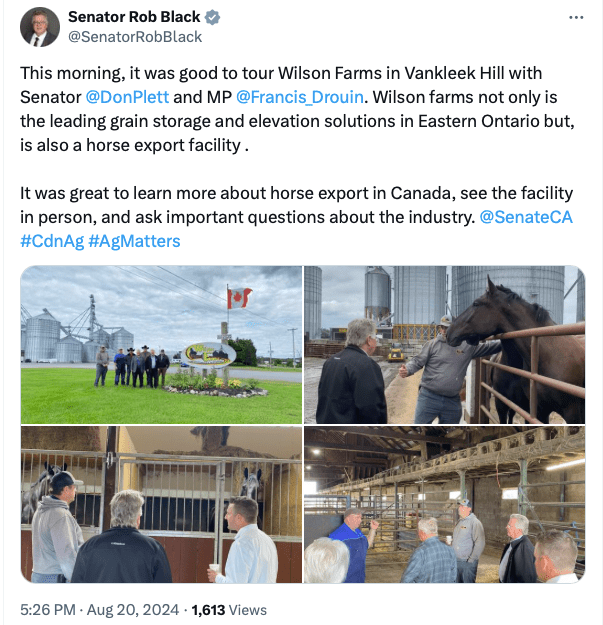
Senator Rob Black, third from the left, opposed Bill C-355 and supports the live export of horses for slaughter.  Kevin Wilson is on the right.

A LITTLE BACKGROUND ON KEVIN WILSON

From an article titled “Busy, successful show season for Wilson Farms Percherons” published by THE REVIEW . CA

“A full schedule of horse shows and agricultural fairs is back across Canada and the United States this year, and that has meant a busy, successful show season for Percheron draught horses from Wilson Farms of Vankleek Hill.

Draught horses have been in our blood for the last three to four generations,” says Kevin Wilson, who co-owns and operates Wilson Farms with his father, Ian Wilson. The main business of Wilson Farms is grain storage and elevation, and they also have beef cattle.

According to Kevin Wilson, the farm has around 300 Percheron draught horses, mostly being raised in Indiana, Ohio, and Missouri. Out of those 300, 11 geldings are used for shows across Canada and the United States. Many of the horses are raised for purchase by Amish farmers in the Midwestern US.”

Further down the article goes on to state:

“So far in 2022, Wilson horses have consistently been in the top five in their classes at draught horse shows locally and in the United States. At the TLA Classic Show in Topeka, Indiana, they placed fourth out of 16 entries in the Classic Series Cart Class, third out of seven teams in the Percheron Six Horse Hitch, first out of 16 teams in the Junior Cart Class, and second out of five teams in Percheron Pair Class.”

You can read the full article here.

CTV W5 EXPOSÉ

Okay, so if you are not aware, in addition to the slaughter of horses being legal and happening within Canada, Canada allows for the live transport of horses to other countries for the purpose of slaughter.

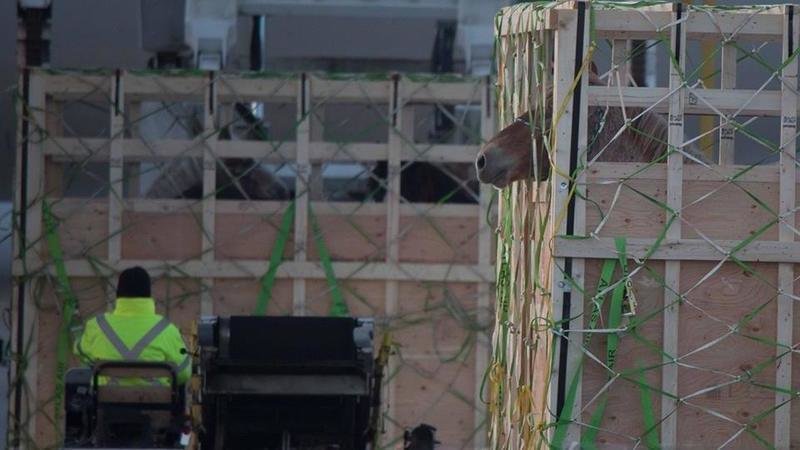
Make no mistake about it, the way in which these horses are transported in no way, shape or form resembles the way show and sport horses are transported.

Horses are crammed in crates, often 3 or even 4 in crates designed for one horse – but don’t take our word for it – watch the full CTV W5 report here.

IATA & CFIA REGULATIONS REGULARLY BROKEN

BELOW you will find a 2 minute video that includes a shipper freely admitting that regulations limiting the length of time horses can be in transport without food, water or veterinary care was recently broken  – with permission of the Canadian Food Inspection Agency (CFIA) – the federal agency charged with protecting the safety of livestock being transported within and out of Canada.

(IATA: International Air Transport Association is the global trade association representing the world’s airlines. IATA sets standards for airline operations, ticketing, cargo transport, safety protocols, and live animal transport regulations used by many carriers worldwide.)

WE ARE CURRENTLY RAISING FUNDS IN SUPPORT OF...

The Bouvry slaughter plant in Alberta is currently closed, though whether that closure is temporary or permanent remains unclear. The plant in Quebec continues to operate.

You might be surprised that in many parts of Canada, independent butchers report receiving requests to slaughter horses alongside other livestock. To some, money is money — and an animal is simply meat so slaughter continues to thrive across Canada.

Ban Horse Slaughter continues to intervene directly — purchasing horses from kill buyers and from pens operated by First Nations Bands before they are shipped for slaughter. With the help of a foster network, we place horses into safe, permanent homes.

MARCH 2026: We are currently raising funds to purchase and support a small group of draft horses from a situation where a kill buyer has offered top dollar.

The costs extend well beyond purchase — transport, feed, veterinary care, and ongoing support.

Ban Horse Slaughter is 100% volunteer-run.

0% goes to salaries.

If you would like to help us continue this work:

BOUVRY HORSE SLAUGHTER PLANT CLOSED

BOUVRY HORSE SLAUGHTER PLANT CLOSED

SIGNS OF CHANGE BUT THE FIGHT IS NOT OVERThere are signs that Canada’s horse slaughter industry is shifting—and not a moment too soon. But while one door may be closing, others remain wide open. Here's what we know right now: 1. Bouvry’s (Horse) Slaughter Plant in...
read more
DEMAND JUSTICE FOR DAKOTA

DEMAND JUSTICE FOR DAKOTA

DON'T LET DAKOTA'S DEATH BE IN VAINCRITICAL UPDATE April 23, 2026 (originally published March 21, 2026): Ultimately, the Crown has the final say on whether criminal charges are laid against Carly Young — so please do NOT stop sharing the following email campaign....

read more
WE LOVE KEYBOARD WARRIORS

WE LOVE KEYBOARD WARRIORS

KEYBOARD WARRIORS ARE INCREDIBLY VALUABLEFirst published, October 13, 2018 - Updated April 19, 2026 The graphic says we love “keyboard warriors” — and we do. Somewhere along the way, that phrase started being used as an insult. A way to dismiss people. To minimize...

read more

HORSES SLAUGHTERED FOR HUMAN CONSUMPTION

Every year thousands of horses are routinely slaughtered in Canada, for human consumption, but you can help us ban horse slaughter in Canada and beyond.

Some of the meat is consumed in Canada, and much of it is shipped to the European Union, and other markets, including Japan.

This barbaric practice is currently not legal in the United States, so horses from the United States are shipped to Canada, and to Mexico, to be slaughtered.

In addition Canada allows for the transportation of live horses to Japan to be slaughtered for human consumption, and unfortunately the transportation of horses destined for slaughter within Canada, and by air to Japan for slaughter, is far from humane.

LEARN MORE HERE <==

T-SHIRTS IN SUPPORT OF HORSE RESCUE FUND 

LIMITED TIME OFFER FREE SHIPPING CANADA & USA 

BAN HORSE SLAUGHTER

FOR HUMAN CONSUMPTION OR ANY PURPOSE
DONATESHOP TO SAVE HORSES
DONE FOR YOU PUSH BUTTON EMAIL CAMPAIGN

DONE FOR YOU PUSH BUTTON EMAIL CAMPAIGN

BOTH AIRLINES OFFER PASSENGER FLIGHTS TOO

Korean Air and All Nippon Airways (ANA) have facilitated the air transport of live horses from Canada to slaughter in Japan. Through cargo operations associated with these airlines, heavy draft horses are shipped on long flights to Japan before being fattened and killed for meat.

We are calling on both airlines to end their role in this trade — and until they do, we are calling for a boycott of Korean Air and All Nippon Airways – both airlines offer passenger flights originating in Canada and the USA.

If you are ready to speak up, the easy-to-send email tools below allow you to contact their leadership directly and make your position clear.

If you’re new to this issue and would like more background first, keep reading — the full explanation follows.

Email Korean Air

Fill in your details and click “Open Email.” Your email app will open with the letter pre-filled and ready to send.


Email All Nippon Airways (ANA)

Fill in your details and click “Open Email.” Your email app will open with the letter pre-filled and ready to send.


Thank you for taking action.

If you’d like to understand exactly why this boycott matters — and what these flights involve — we’ve laid it out clearly below.

WHAT MOST CANADIANS & AMERICANS DON’T REALIZE…

Most Canadians do not realize that horses are not only slaughtered within Canada — they are also exported live by air for slaughter overseas. Japan is the primary destination.

The horses shipped from Canada for slaughter are heavy, muscular draft horses — including Belgians, Percherons, and draft crosses — bred for showing, driving competitions, farm and carriage work, and sale into Amish and Mennonite communities as working horses.

For years, the public was told these horses were purpose-bred for meat. But in an interview with the publication, ‘Ontario Farmer’, Kevin Wilson — widely described as the largest facilitator of these exports — referred to many of them as “surplus” horses.

That word ‘surplus’ matters.

Because horses not originally raised within a meat production system are not managed under strict food-animal drug protocols. They are treated as horses — with wormers, anti-inflammatories, and phenylbutazone (“bute”), medications clearly labeled as not permitted for animals entering the human food chain.

When those same horses are later deemed “surplus” and redirected into the export pipeline, they carry treatment histories that were never intended for meat production.

AND THEN THERE IS HOW THEY ARE TRANSPORTED

The way these horses are shipped bears no resemblance to the care given to race or sport horse traveling within Canada or internationally for competition or sale.

Performance horses travel in individual metal air stalls, fitted with protective gear, accompanied by dedicated grooms, monitored throughout the journey, and provided regular food and water.

Draft horses bound for slaughter are loaded three or four at a time into wooden crates and transported as cargo.

From the time they leave the feedlot for the airport, through loading, flight, unloading, and transfer after landing in Japan, they are not provided food or water.

Canadian regulations permit horses to be transported for up to 28 hours without feed, water, or rest — and flight schedules and delays can push transport times to, and many times beyond, that limit.

This is not what humane transport looks like.

THE AIRLINES INVOLVED

Two of the airlines that have facilitated these shipments are Korean Air and All Nippon Airways (ANA).

These are not obscure freight operators. They are major international passenger airlines with recognizable brands and loyal customers.

All Nippon Airways operates direct passenger flights from Vancouver to Tokyo and serves major U.S. cities including Los Angeles, San Francisco, Seattle, Chicago, Houston, and New York.

Korean Air operates passenger routes from Vancouver and Toronto to Seoul and flies extensively from U.S. hubs such as Los Angeles, San Francisco, Seattle, Dallas, Chicago, New York, Atlanta, and Honolulu.

These are airlines families use for vacations, business trips, and visits with loved ones.

Most passengers have no idea that the same corporate entities have facilitated the transport of live horses from Canada to slaughter in Japan.

But once we know, we have a choice.

Airlines respond to revenue and reputation. When customers speak clearly — and when enough customers choose differently — companies listen.

WHAT CAN YOU DO?

We are calling on Korean Air and All Nippon Airways to end their role in transporting horses from Canada to slaughter. Until that happens, we are asking travelers to book with other airlines and to make it known why.

If you are planning travel to Asia, choose an airline that does not participate in this trade.

If you care about animal welfare, share this information and start the conversation.

If you want policy to change, lend your voice to the growing call for transparency and humane reform.

Ending live horse exports from Canada will require public pressure, political will, and corporate accountability.

That pressure begins with informed consumers.

And it grows when people decide that convenience will no longer outweigh conscience.

P.S. If you believe this work matters, please consider supporting it.  We are a volunteer-run organization — no salaries, no paid executives — and every dollar goes directly toward public education, outreach, research, and policy advocacy aimed at ending slaughter of horses within Canada and live horse exports from Canada for slaughter.

Your support helps keep this issue in front of decision-makers and moves us closer to real reform.

JUST IN CASE THE FORMS ABOVE DID NOT WORK FOR YOU…

LETTER 1

To: Korean Air

Send To (Email): customersvc@koreanair.com

Website: https://www.koreanair.com

Phone (Canada): 1-800-438-5000

Phone (Korea HQ): +82-1588-2001

Canadian Office (Toronto – Passenger Sales Office):

Korean Air
Suite 2101, 150 King Street West
Toronto, ON M5H 1J9
Canada

Head Office (Seoul):
Korean Air Lines Co., Ltd.
260, Haneul-gil, Gangseo-gu
Seoul 07505
Republic of Korea

Letter Text

Subject: Request for Action — End involvement in live horse exports from Canada for slaughter

Dear Mr. Cho and the Executive Leadership Team at Korean Air,

I am writing as a concerned traveler regarding Korean Air’s role in transporting live horses from Canada to slaughter in Japan.

Public records and documented flight tracking have shown that heavy draft horses — including Belgians, Percherons, and draft crosses — are being exported by air from Canada for slaughter.

These long-haul shipments expose horses to extended confinement, food and water deprivation permitted under transport regulations, and significant welfare risks.

While cargo operations may be handled separately from passenger services, Korean Air is a single corporate brand in the eyes of the public. Many customers would be deeply troubled to learn that an airline they trust for international travel has been involved in facilitating this trade.

I respectfully urge Korean Air to publicly commit to ending any involvement in the live export of horses from Canada for slaughter.

Until such a commitment is made, I will be choosing other airlines for international travel and encouraging others to do the same.

Sincerely,

[Full Name]
[City, Province/State, Country]
[Email]

———-

LETTER 2

To: All Nippon Airways (ANA)

Send To (Email): csr@ana.co.jp

Website: https://www.ana.co.jp

Phone (North America Reservations): 1-800-235-9262

Phone (Japan HQ): +81-3-6704-5555

Canadian Office (Vancouver – Passenger Sales Office):

All Nippon Airways Co., Ltd.
Suite 1800 – 200 Burrard Street
Vancouver, BC V6C 3L6
Canada

Head Office (Tokyo):

All Nippon Airways Co., Ltd.
Shiodome City Center
1-5-2 Higashi-Shimbashi
Minato-ku, Tokyo 105-7133
Japan

Letter Text

Subject: Corporate Responsibility Concern — End involvement in live horse exports from Canada for slaughter

Dear Executive Leadership Team at All Nippon Airways,

I am writing regarding All Nippon Airways’ corporate association with cargo operations that have transported live horses from Canada to slaughter in Japan.

These shipments involve heavy draft horses exported on long international flights under conditions that many members of the public consider inconsistent with humane treatment. The practice raises serious ethical and reputational concerns.

Although passenger and cargo operations may be structured separately, All Nippon Airways and its affiliated cargo services operate under a shared corporate identity. Consumers increasingly expect airlines to uphold responsible standards across all divisions of their business.

I am respectfully asking All Nippon Airways to publicly commit to ending any involvement in the transport of live horses from Canada for slaughter.

Until that commitment is made, I will be choosing other airlines for my travel and encouraging others to do the same.

Sincerely,

[Full Name]
[City, Province/State, Country]
[Email]

BOUVRY HORSE SLAUGHTER PLANT CLOSED

BOUVRY HORSE SLAUGHTER PLANT CLOSED

SIGNS OF CHANGE BUT THE FIGHT IS NOT OVERThere are signs that Canada’s horse slaughter industry is shifting—and not a moment too soon. But while one door may be closing, others remain wide open. Here's what we know right now: 1. Bouvry’s (Horse) Slaughter Plant in...

read more
DEMAND JUSTICE FOR DAKOTA

DEMAND JUSTICE FOR DAKOTA

DON'T LET DAKOTA'S DEATH BE IN VAINCRITICAL UPDATE April 23, 2026 (originally published March 21, 2026): Ultimately, the Crown has the final say on whether criminal charges are laid against Carly Young — so please do NOT stop sharing the following email campaign....

read more
WE LOVE KEYBOARD WARRIORS

WE LOVE KEYBOARD WARRIORS

KEYBOARD WARRIORS ARE INCREDIBLY VALUABLEFirst published, October 13, 2018 - Updated April 19, 2026 The graphic says we love “keyboard warriors” — and we do. Somewhere along the way, that phrase started being used as an insult. A way to dismiss people. To minimize...

read more

HORSES SLAUGHTERED FOR HUMAN CONSUMPTION

Every year thousands of horses are routinely slaughtered in Canada, for human consumption, but you can help us ban horse slaughter in Canada and beyond.

Some of the meat is consumed in Canada, and much of it is shipped to the European Union, and other markets, including Japan.

This barbaric practice is currently not legal in the United States, so horses from the United States are shipped to Canada, and to Mexico, to be slaughtered.

In addition Canada allows for the transportation of live horses to Japan to be slaughtered for human consumption, and unfortunately the transportation of horses destined for slaughter within Canada, and by air to Japan for slaughter, is far from humane.

LEARN MORE HERE <==

We are 100% volunteer & crowdfunded.

0% goes towards salaries. Yes, ZERO.

JOIN ACTOR KATE DRUMMOND &

HELP US SPREAD THE WORD

BAN HORSE SLAUGHTER

FOR HUMAN CONSUMPTION OR ANY PURPOSE
DONATESHOP TO SAVE HORSES

WHO SHIPS HORSES TO JAPAN FOR SLAUGHTER?

WHO SHIPS HORSES TO JAPAN FOR SLAUGHTER?

First published August 31, 2022 – UPDATED December 14, 2024.

Have you ever wondered who is behind exporting horses from Canada to Japan for the purpose of slaughter for human consumption?

According to an article from Ontario Farmer magazine titled:

HORSES STILL HEAD TO JAPAN

(Print Edition) Tuesday, Aug 30, 2022

Page: B13

Section: Livestock

Kevin Wilson‘s diversified farming operation at Vankleek Hill [Ontario, Canada] facilitates the majority of these exports.”

By “these” exports the article means horses exported from Canada to Japan for the purpose of slaughter for human consumption.

The article goes on to say: 

“Thinly sliced horse meat, called basashi, is a sought after product in Japan and is a great export market, adding value to farmers for Canada’s surplus horses, he [Kevin Wilson] said.”

SO WHO IS KEVIN WILSON?

You may be surprised to learn that according to Facebook, Twitter and YouTube accounts and various articles in the press,  Kevin Wilson not only breeds and raises Percherons, his farm business owns 300 Percherons and he shows Percherons at fairs and events in Canada and the USA.

Are you shocked that someone who shows horses would facilitate the shipment of horses to slaughter?

SURPLUS HORSES?

We found the use of the word “surplus” in the article from Ontario Farmer interesting.

For years we’ve been led to believe that horses shipped to Japan for slaughter were specifically bred for that purpose, yet according to the article Kevin Wilson stated…

“Japan…”  “is a great export market, adding value to farmers for Canada’s surplus horses…”

Could it be that at least some of the “surplus” horses were not purpose bred and that some of those shipped to Japan are treated with drugs typically used on horses – for example wormers and BUTE –  drugs known to be toxic to humans?

Scroll down to learn more about Kevin Wilson.

Kevin Wilson features the picture above on his farm’s Twitter account.

With the caption…

“Something special about a girl and her horse”.

We found that an interesting quote from someone who ships his “surplus horses” to Japan by air to be slaughtered for human consumption.
A LITTLE BACKGROUND ON KEVIN WILSON

From an article titled “Busy, successful show season for Wilson Farms Percherons” published by THE REVIEW . CA

“A full schedule of horse shows and agricultural fairs is back across Canada and the United States this year, and that has meant a busy, successful show season for Percheron draught horses from Wilson Farms of Vankleek Hill.

Draught horses have been in our blood for the last three to four generations,” says Kevin Wilson, who co-owns and operates Wilson Farms with his father, Ian Wilson. The main business of Wilson Farms is grain storage and elevation, and they also have beef cattle.

According to Kevin Wilson, the farm has around 300 Percheron draught horses, mostly being raised in Indiana, Ohio, and Missouri. Out of those 300, 11 geldings are used for shows across Canada and the United States. Many of the horses are raised for purchase by Amish farmers in the Midwestern US.”

Further down the article goes on to state:

“So far in 2022, Wilson horses have consistently been in the top five in their classes at draught horse shows locally and in the United States. At the TLA Classic Show in Topeka, Indiana, they placed fourth out of 16 entries in the Classic Series Cart Class, third out of seven teams in the Percheron Six Horse Hitch, first out of 16 teams in the Junior Cart Class, and second out of five teams in Percheron Pair Class.”

You can read the full article here.

CTV W5 COVERAGE…

Okay, so if you are not aware, Canada allows for the live transport of horses to other countries for the purpose of slaughter.

Make no mistake about it, the way in which these horses are transported in no way shape or form resembles the way show and sporting horses are transported.

Horses are crammed in crates, often 3 or even 4 in crates designed for one horse – but don’t take our word for it – watch the full CTV W5 report here.

BELOW you will find a 2 minute video that includes a shipper freely admitting that regulations limiting the length of time horses can be in transport without food, water or veterinary care was recently broken  – with permission of the CFIA – the federal agency charged with protecting the safety of livestock being transported within and out of Canada.

 Retired CFIA Veterinarian speaks out against horse slaughter.

We are 100% volunteer & crowdfunded.
0% goes towards salaries. Yes, ZERO.


You do NOT need a PayPal account to donate through PayPal.

You may make a one time donation or if you prefer set up a monthly donation.

EMAIL for e-transfer or PayPal: 

donations@banhorseslaughter.com

If asked for a security answer please use horses

T-SHIRTS IN SUPPORT OF HORSE RESCUE FUND 

LIMITED TIME OFFER FREE SHIPPING CANADA & USA 
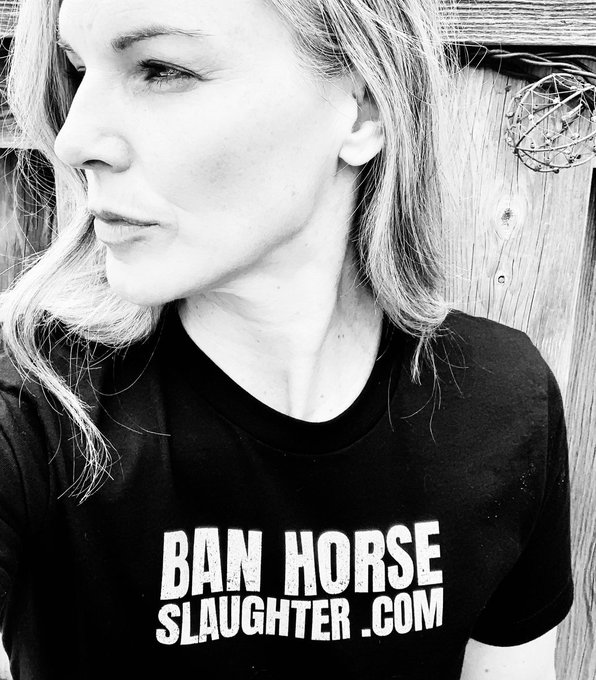
BAN HORSE SLAUGHTER

FOR HUMAN CONSUMPTION OR ANY PURPOSE
DONATESHOP TO SAVE HORSES

Pin It on Pinterest