No Results Found
The page you requested could not be found. Try refining your search, or use the navigation above to locate the post.



Conservative MP Lianne Rood who voted against Bill C-355 going to committee questioned Director of Legal Advocacy for Animal Justice Canada, Kaitlyn Mitchell…

The brief mentioned in video, jointly submitted by Canadian veterinarians who may not all be practicing equine veterinarians but that doesn't mean that their opinion in the matter of animal welfare is not valuable. [OPEN the BRIEF HERE.]
Conservative MP Lianne Rood who voted against Bill C-355 is adamant that the way in which horses are shipped to slaughter in no way differs from the way in which pet, show, sport and race horses are shipped.
We beg to differ and video by CTV W5, CBC The National (scroll down) along with the expert witness in the video immediately below prove that horses destined for slaughter are not given the same care when shipped.

You may not be aware but in addition to allowing the slaughter of horses within Canada for human consumption — Canada allows for the live transport of horses to other countries for the purpose of slaughter.
Make no mistake about it, the way in which horses destined to be slaughtered are transported, in no way shape or form resembles the great care, when being shipped by air shown to pet or show or sport horses – including racehorses.
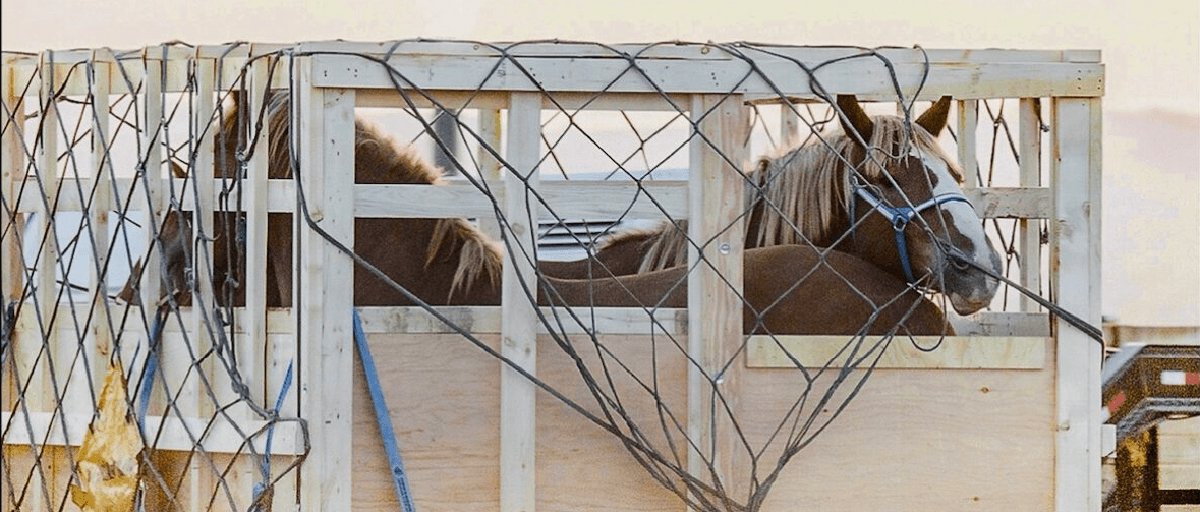
Horses destined for slaughter are crammed in crates, often 3 or even 4 in crates designed for one horse – but don’t take our word for it – watch the full CTV W5 report here or a shorter 2 minute video below.

We are 100% volunteer & crowdfunded.
0% goes towards salaries. Yes, ZERO.
You do NOT need a PayPal account to donate through PayPal.
You may make a one time donation or if you prefer set up a monthly donation.

EMAIL for e-transfer or PayPal:
donations@banhorseslaughter.com
If asked for a security answer please use horses


The page you requested could not be found. Try refining your search, or use the navigation above to locate the post.
Help spread the word by sharing this email campaign with friends and family! You can also support the cause by donating—your contribution will help fund advertising efforts to raise awareness and push for change. Every action makes a difference!

FEB 14, 2024:
Most of us will not be surprised that producers of beef and other meat within Canada are in favour of continuing the live export of horses for the purpose of slaughter. [Scroll down for a list.]
Meat producers are afraid that if Bill C-355 passes, advocates will come after them and ban the live export of other sentient beings for the purpose of slaughter. Even though this bill has nothing to do with any species other than horses.
We “almost get” that meat producers are afraid — although we also know that within each organization there are horse lovers who even though they slaughter cattle — are opposed to the slaughter of horses or the export for that purpose.
BUT what about Equestrian Canada and Spruce Meadows – opposing the banning of the live export of horses for the purpose of slaughter? Are we the only ones who find that their names on the list of those opposed to Bill C-355 is surprising?
Scroll down for “testimony” given by Equestrian Canada during the committee proceedings.
FEB. 13, 2024:
From the Minutes of the first session on Bill C-355 by the Standing Committee on Agriculture and Agri-food:
MP Warren Steinley (Conservative):
I have a list of stakeholders who do NOT support Bill C-355.
It’s something that I’d like to put into the record.
Some of my colleagues have said that this is a pan-Canadian approach and that lots of people across the country are in favour of this, but lots of groups have questions and concerns about this.
The list includes the following:
the Air Line Pilots Association Canada;
Alberta Auction Markets Association;
Alberta Beef Producers;
Alberta Breeder Finance Inc.;
Alberta Grazing Leaseholders Association;
Beef Farmers of Ontario;
British Columbia Cattlemen’s Association;
Canadian Cattle Association;
Canadian Equine Exporters Association;
Canadian Meat Council;
Canadian Federation of Agriculture;
Egg Farmers of Alberta;
Equestrian Canada;
Feeder Associations of Alberta Limited;
Horse Welfare Alliance of Canada [Do NOT let that name fool you, they advocate for slaughter of horses within Canada];
Livestock Markets Association of Canada;
Les Producteurs de bovins du Québec;
Manitoba Beef Producers;
members of the Métis Nation of Alberta;
New Brunswick Cattle Producers;
Nova Scotia Cattle Producers;
Saskatchewan cattle producers;
Spruce Meadows;
Prince Edward Island Cattle Producers;
Western Cash Advance Program Inc.;
and Western Stock Growers’ Association.
P.S. With the Canadian Food Inspection Agency NOT surprised that horse meat is being passed off as other than horse meat in Canadian grocery stores we think producers of other meat within Canada would be better served going after the domestic slaughter of horses for human consumption rather than opposing a bill to ban the live export of horses to slaughter.
UPDATE FEB. 29, 2024:
A representative from Equestrian Canada, Ms. Melanie McLearon, Director of Marketing and Communications, gave testimony during the second session of the Standing Committee on Agriculture and Agri-food. We’ve included her testimony below.
Please note Bill C-355 IF passed allows for an 18 month transition time meaning that for 18 months (again IF the bill passes) those shipping horses to slaughter will still be able to ship horses to Japan or other markets for the purpose of slaughter or for fattening for slaughter.
It appears Equine Canada are “okay” with horses being shipped to slaughter but worried about those same horses if the ability to be shipped to slaughter outside of the country goes away?
We are also surprised that given the fact that the paperwork required to slaughter a horse within Canada is an EID (Equine Identification Document), and is extremely minimal in scope and is on the “honour system” — we are shocked there would be any concern over “extra” paperwork. (We like to remind people how easy it is for a stolen horse to be slaughtered within Canada – and have several cases documented here and here.)
Is extra paperwork not worth it when it comes to stopping the barbaric practice of sending horses to Japan or other markets to be slaughtered? Or are we missing something?
When shipping horses internationally, “agents” familiar with the rules and regulations are the order of the day – and other countries have sections in documents for shipping requiring that horses are marked as NOT being intended for slaughter. Those competing internationally with their horses can attest to this. Surely a little extra paperwork is worth banning the export of horses for the purpose of slaughter.
That any equine organization professing to love horses would be complaining about “extra” paperwork is beyond us.
To say we are disappointed in the response from Equine Canada is an understatement.
You may not be aware but in addition to allowing the slaughter of horses within Canada for human consumption — Canada allows for the live transport of horses to other countries for the purpose of slaughter.
Make no mistake about it, the way in which horses destined to be slaughtered are transported, in no way shape or form resembles the great care, when being shipped by air shown to pet or show or sport horses – including racehorses.
Horses destined for slaughter are crammed in crates, often 3 or even 4 in crates designed for one horse – but don’t take our word for it – watch the full CTV W5 report here or a shorter 2 minute video below.
BELOW you will find a 2 minute video that includes a shipper freely admitting that regulations limiting the length of time horses can be in transport without food, water or veterinary care was recently broken – with permission of the CFIA – the federal agency charged with protecting the safety of livestock being transported within and out of Canada.
We are 100% volunteer & crowdfunded.
0% goes towards salaries. Yes, ZERO.
You do NOT need a PayPal account to donate through PayPal.
You may make a one time donation or if you prefer set up a monthly donation.
EMAIL for e-transfer or PayPal:
donations@banhorseslaughter.com
If asked for a security answer please use horses
The page you requested could not be found. Try refining your search, or use the navigation above to locate the post.
Help spread the word by sharing this email campaign with friends and family! You can also support the cause by donating—your contribution will help fund advertising efforts to raise awareness and push for change. Every action makes a difference!

Standing Committee on Agriculture and Agri-food – second session on Bill C-355.
Witness:
MS. Shannon Nix
Assistant Deputy Minister department of Agriculture & Agri-food Canada.
You may not be aware but in addition to allowing the slaughter of horses within Canada for human consumption — Canada allows for the live transport of horses to other countries for the purpose of slaughter.
Make no mistake about it, the way in which horses destined to be slaughtered are transported, in no way shape or form resembles the great care, when being shipped by air shown to pet or show or sport horses – including racehorses.
Horses destined for slaughter are crammed in crates, often 3 or even 4 in crates designed for one horse – but don’t take our word for it – watch the full CTV W5 report here or a shorter 2 minute video below.
We are 100% volunteer & crowdfunded.
0% goes towards salaries. Yes, ZERO.
You do NOT need a PayPal account to donate through PayPal.
You may make a one time donation or if you prefer set up a monthly donation.
EMAIL for e-transfer or PayPal:
donations@banhorseslaughter.com
If asked for a security answer please use horses
The page you requested could not be found. Try refining your search, or use the navigation above to locate the post.
Help spread the word by sharing this email campaign with friends and family! You can also support the cause by donating—your contribution will help fund advertising efforts to raise awareness and push for change. Every action makes a difference!

BELOW you will find a 2 minute video that includes a shipper freely admitting that regulations limiting the length of time horses can be in transport without food, water or veterinary care was recently broken – perhaps with permission of the CFIA – the federal agency charged with protecting the safety of livestock being transported within and out of Canada.
Well, thanks to Animal Justice Canada that shipper is facing federal charges.
Animal Justice has successfully laid a federal charge against a Manitoba horse export business – CAROLYLE FARMS, Swan River, Manitoba, Canada.
The charge?
Failing to have a contingency plan after a shipment of live horses from Canada destined for slaughter in Japan for human consumption, exceeded the 28-hour time limit allowed by national and international regulations governing the transport of horses.
At least 3 horses collapsed during the gruelling flight mentioned in the CBC piece. 2-minute video from the broadcast archived above.
Multiple horses are crammed in crates designed for one horse and are not fed or watered during their time in transport.
How horses are shipped to slaughter in no way resembles how show, pet or race or other sport horses are transported.
CBC’s The National carried the story of a recent shipment with Mr. Lyle Lumax admitting he knew as did the CFIA before the flight — that the horses were going to exceed the travel time allowed by both national and International regulations.
You may not be aware but in addition to allowing the slaughter of horses within Canada for human consumption — Canada allows for the live transport of horses to other countries for the purpose of slaughter.
Make no mistake about it, the way in which horses destined to be slaughtered are transported, in no way shape or form resembles the great care, when being shipped by air shown to pet or show or sport horses – including racehorses.
Horses destined for slaughter are crammed in crates, often 3 or even 4 in crates designed for one horse – but don’t take our word for it – watch the full CTV W5 report here or a shorter 2 minute video above.
We are 100% volunteer & crowdfunded.
0% goes towards salaries. Yes, ZERO.
You do NOT need a PayPal account to donate through PayPal.
You may make a one time donation or if you prefer set up a monthly donation.
EMAIL for e-transfer or PayPal:
donations@banhorseslaughter.com
If asked for a security answer please use horses
The page you requested could not be found. Try refining your search, or use the navigation above to locate the post.
Help spread the word by sharing this email campaign with friends and family! You can also support the cause by donating—your contribution will help fund advertising efforts to raise awareness and push for change. Every action makes a difference!

Thank you Animal Justice Canada for submitting a brief on Bill C-355 for the Standing Committee on Agriculture and Agri-food. Your attention to this matter is greatly appreciated.
I write on behalf of Animal Justice – Canada’s leading national animal law organization – to voice our strong support for Bill C-355, the Prohibition of the Export of Horses by Air for Slaughter Act. Shipping live horses from Canada to Japan for slaughter causes signficant and unnecessary suffering and distress to draft horses, approcimately 2,000 of whom are forced to endure this gruelling journey eveyr year. The practice is opposed by every major animal protection group in the country, leading veterinary and animal welfare experts, and the majority of Canadians of all political stripes. A Parliamentary e-petition in support of a ban on horse exports overseas for slaughter presented by MP Alistair MacGregor recently amassed over 36,000 signatories from across the country.
You may not be aware but in addition to allowing the slaughter of horses within Canada for human consumption — Canada allows for the live transport of horses to other countries for the purpose of slaughter.
Make no mistake about it, the way in which horses destined to be slaughtered are transported, in no way shape or form resembles the great care, when being shipped by air shown to pet or show or sport horses – including racehorses.
Horses destined for slaughter are crammed in crates, often 3 or even 4 in crates designed for one horse – but don’t take our word for it – watch the full CTV W5 report here or a shorter 2 minute video below.
BELOW you will find a 2 minute video that includes a shipper freely admitting that regulations limiting the length of time horses can be in transport without food, water or veterinary care was recently broken – with permission of the CFIA – the federal agency charged with protecting the safety of livestock being transported within and out of Canada.
We are 100% volunteer & crowdfunded.
0% goes towards salaries. Yes, ZERO.
You do NOT need a PayPal account to donate through PayPal.
You may make a one time donation or if you prefer set up a monthly donation.
EMAIL for e-transfer or PayPal:
donations@banhorseslaughter.com
If asked for a security answer please use horses
The page you requested could not be found. Try refining your search, or use the navigation above to locate the post.
Help spread the word by sharing this email campaign with friends and family! You can also support the cause by donating—your contribution will help fund advertising efforts to raise awareness and push for change. Every action makes a difference!

First published August 31, 2022 – UPDATED December 14, 2024.
Have you ever wondered who is behind exporting horses from Canada to Japan for the purpose of slaughter for human consumption?
According to an article from Ontario Farmer magazine titled:
HORSES STILL HEAD TO JAPAN
(Print Edition) Tuesday, Aug 30, 2022
Page: B13
Section: Livestock
“Kevin Wilson‘s diversified farming operation at Vankleek Hill [Ontario, Canada] facilitates the majority of these exports.”
By “these” exports the article means horses exported from Canada to Japan for the purpose of slaughter for human consumption.
The article goes on to say:
“Thinly sliced horse meat, called basashi, is a sought after product in Japan and is a great export market, adding value to farmers for Canada’s surplus horses, he [Kevin Wilson] said.”
You may be surprised to learn that according to Facebook, Twitter and YouTube accounts and various articles in the press, Kevin Wilson not only breeds and raises Percherons, his farm business owns 300 Percherons and he shows Percherons at fairs and events in Canada and the USA.
Are you shocked that someone who shows horses would facilitate the shipment of horses to slaughter?
We found the use of the word “surplus” in the article from Ontario Farmer interesting.
For years we’ve been led to believe that horses shipped to Japan for slaughter were specifically bred for that purpose, yet according to the article Kevin Wilson stated…
“Japan…” “is a great export market, adding value to farmers for Canada’s surplus horses…”
Could it be that at least some of the “surplus” horses were not purpose bred and that some of those shipped to Japan are treated with drugs typically used on horses – for example wormers and BUTE – drugs known to be toxic to humans?
Scroll down to learn more about Kevin Wilson.

Kevin Wilson features the picture above on his farm’s Twitter account.
With the caption…
“Something special about a girl and her horse”.
We found that an interesting quote from someone who ships his “surplus horses” to Japan by air to be slaughtered for human consumption.
From an article titled “Busy, successful show season for Wilson Farms Percherons” published by THE REVIEW . CA
“A full schedule of horse shows and agricultural fairs is back across Canada and the United States this year, and that has meant a busy, successful show season for Percheron draught horses from Wilson Farms of Vankleek Hill.
Draught horses have been in our blood for the last three to four generations,” says Kevin Wilson, who co-owns and operates Wilson Farms with his father, Ian Wilson. The main business of Wilson Farms is grain storage and elevation, and they also have beef cattle.
According to Kevin Wilson, the farm has around 300 Percheron draught horses, mostly being raised in Indiana, Ohio, and Missouri. Out of those 300, 11 geldings are used for shows across Canada and the United States. Many of the horses are raised for purchase by Amish farmers in the Midwestern US.”
Further down the article goes on to state:
“So far in 2022, Wilson horses have consistently been in the top five in their classes at draught horse shows locally and in the United States. At the TLA Classic Show in Topeka, Indiana, they placed fourth out of 16 entries in the Classic Series Cart Class, third out of seven teams in the Percheron Six Horse Hitch, first out of 16 teams in the Junior Cart Class, and second out of five teams in Percheron Pair Class.”
Okay, so if you are not aware, Canada allows for the live transport of horses to other countries for the purpose of slaughter.
Make no mistake about it, the way in which these horses are transported in no way shape or form resembles the way show and sporting horses are transported.
Horses are crammed in crates, often 3 or even 4 in crates designed for one horse – but don’t take our word for it – watch the full CTV W5 report here.
BELOW you will find a 2 minute video that includes a shipper freely admitting that regulations limiting the length of time horses can be in transport without food, water or veterinary care was recently broken – with permission of the CFIA – the federal agency charged with protecting the safety of livestock being transported within and out of Canada.

Retired CFIA Veterinarian speaks out against horse slaughter.
We are 100% volunteer & crowdfunded.
0% goes towards salaries. Yes, ZERO.
You do NOT need a PayPal account to donate through PayPal.
You may make a one time donation or if you prefer set up a monthly donation.
EMAIL for e-transfer or PayPal:
donations@banhorseslaughter.com
If asked for a security answer please use horses
The page you requested could not be found. Try refining your search, or use the navigation above to locate the post.
Help spread the word by sharing this email campaign with friends and family! You can also support the cause by donating—your contribution will help fund advertising efforts to raise awareness and push for change. Every action makes a difference!