
Santa Anita Horse Racing Track 23rd Horse Dead in 3 Months

Santa Anita Horse Racing Track 23rd Horse Dead in 3 Months

With special thanks to KTLA 5.

A 23rd horse fatality has occurred at Santa Anita since Dec. 26 when Arms Runner fell on the dirt crossover portion of the hillside turf course Sunday and was later euthanized. La Sardane, who was behind Arms Runner, couldn’t avoid the fallen horse, tripped and went to the ground, but got right back up.

The death was confirmed by Dr. Rick Arthur, equine medical director of the California Horse Racing Board.

The jockeys Martin Pedroza, aboard Arms Runner, and Ruben Fuentes were believed to have sustained no more than bumps and bruises although they were taken off their remaining mounts.

The accident occurred in the feature race of the day, the Grade 3 $100,000 San Simeon Stakes, a 6 1/2 furlong turf race that starts at the top of a hillside and has a crossover point on dirt. The spill happened just as the horses were about to re-enter the turf portion of the course. It appeared that Arms Runner injured his right front leg.

Scott Martelle of the Los Angeles Times writes: 

I’m a horse racing fan, but I won’t be at Santa Anita on Saturday

A few months ago, I marked Saturday down on my calendar as Santa Anita Derby day to ensure I wouldn’t miss one of the top annual races at the famed horse track in Arcadia. It’s a big deal in horse racing — the winner of the $1-million purse also gets a near-automatic entry in next month’s Kentucky Derby.

I was in the stands last spring when Justify won to qualify for the Kentucky Derby, which he also won en route to becoming only the 13th horse to win the Triple Crown, horse racing’s holy grail. (The first horse to win the Kentucky Derby, the Preakness Stakes and the Belmont Stakes was Sir Barton in 1919).


So the Santa Anita Derby is a big deal. But I’m not going to the track Saturday after all. There have been too many dead horses, and not enough answers.


How many dead horses? Over the last three months 23 horses have died in races or training at the park. By contrast, 37 horses died over seven months in 2017-18.

The current rate is a troubling spike in a sport that already contributes to the deaths of some 500 horses a yearnationwide, out of tens of thousands of horses that compete in nearly 40,000 races a year.


The tough question is deciding what the threshold should be for acceptable levels of hurt horses, whose physiology means that a broken leg can be a fatal injury.


I’m not sure what that answer is, and in some ways it’s a personal call. And while I won’t be at the track this weekend, thousands of my fellow horse racing enthusiasts will be.

There have been too many dead horses, and not enough answers.

The most troubling aspect is that Santa Anita track officials have decided to continue racing despite not knowing why so many horses are suffering such debilitating injuries.


To their credit, track officials have paused racing three times to conduct tests and studies in hopes of determining whether a winter of heavy rains has affected the track or whether there are other identifiable causes. Yet they have found no definitive answers, and each time racing resumed more horses died, the most recent on Sunday as the horse fell mid-race where a dirt track crosses the downhill turf course.


It’s a tough call. Horse racing is entertainment for those of us who like to sit in the stands, bet and cheer on the horses and jockeys, soak in the singular beauty of the San Gabriel Mountains rising north of the track, and enjoy a day that at once feels disconnected from daily life in Los Angeles, yet is also quintessentially Los Angeles. The current track has been there since 1934, and to step onto the grounds is to step back in time.


Yet Santa Anita is also a business. Hundreds of jobs intersect with the track, including grounds employees, betting tellers, the stable hands and trainers. Shutting down causes significant economic pain for those who depend on the track for a living.


But the dead horses

As a culture, we tend to like our sports with an edge of toughness. Football, hockey, basketball, even baseball are games that involve sometimes violent collisions, often leading to painful career-derailing injuries and, on rare occasions, death. We’re still trying to grapple with the issue of head traumas suffered by young athletes that develop into progressive brain disease later in life.

In hockey, fights are part of the game, and acts that would lead to jail time if committed on a sidewalk get players a two-minute timeout. Not to mention boxing and mixed martial arts, whose bouts would be felonies were it not for sanctioning agencies.


But those who engage in such sports do so willingly. Thoroughbred horses, on the other hand, have no choice in the matter (much like the animals that we make our pets). They are bred for one main purpose — to race. And when they can’t, or when they are too slow to be competitive, tens of thousands of them are packed off to slaughterhouses.

But is that any crueler than raising cows and chickens for meat? Again, how distressing that is a personal view, so long as the animals are cared for humanely while they are alive.


And my personal view is that too much is unanswered about the horse deaths at Santa Anita for me to sit in the stands Saturday, place my bets and hope to see in person another top contender for the Kentucky Derby and, as a long shot, the Triple Crown.


Horse racing may be the sport of kings, but it survives on the patronage of everyday fans. I hit the track four or five times a year, and at the moment, my patronage is wavering.

T-SHIRTS IN SUPPORT OF HORSE RESCUE FUND 

LIMITED TIME OFFER FREE SHIPPING CANADA & USA 
BAN HORSE SLAUGHTER

FOR HUMAN CONSUMPTION OR ANY PURPOSE
DONATESHOP TO SAVE HORSES

Stolen Horse Owner becomes Anti Horse Slaughter Advocate

Stolen Horse Owner becomes Anti Horse Slaughter Advocate

In late Septemer 2018, the horse world in Canada was captivated and hearts went out to Cindy Thomas, the owner of a stolen Clydesdale mare named Molly.

The story spread like wildfire and was instrumental in educating more Canadians than ever to the fact that horses are routinely slaughtered in Canada for human consumption.

Yes, really.

Horse meat is consumed in Canada, and much of what is “processed” in Canada is shipped to other markets including, but not limited to the Eurpoean Union, Japan, China and South Korea.

This barbaric practice is currently not allowed in the United States but American horses are routinely shipped to Canada and Mexico to be slaughtered for human consumption.

Molly’s owner Cindy Thomas was shocked to learn that when horses are sold to, and dropped off, at slaughter plants in Canada, that unless a horse has a visible brand, that same horse or horses can be slaughtered the same day they are delivered.  The only proof of ownership required is for the person, or persons, dropping off the horse or horses to claim that they are the rightful owners.


 City TV Edmonton was the first to pick up the story, and Cindy who was just starting to understand the horrors of horse slaughter did an amazing job of making sure those watching knew there was a chance that her stolen horse (or any other horse in Canada) could be slaughtered for human consumption.  You can watch the news clip by clicking here.

City TV Edmonton also did a follow up story and once again Cindy Thomas managed to make sure that those watching realized that horse slaughter for human consumption is something that is allowed in Canada.  You can watch the 2 minute follow up story by clicking here.

The CTV Edmonton News Report about Molly the missing Clydesdale references a story from 2017, where two pet horses were slaughtered for human consumption.  Details on that story may be found by clicking here.

Global TV Edmonton ran the video above and an article here.

Thankfully Molly was found wandering near Cindy’s home on December 24th, 2018.

She was in decent shape, her mane and tail recently brushed, and free of debris.

She was obviously being hidden some where, and because the press and the public did not let up on pressure to find her, she was set loose by those who had stolen her months before.

Since Molly’s return Cindy Thomas has become an even more outspoken advocate for horses who might other wise be slaughtered for human consumption.

Cindy has networked and put together a team of like minded individuals, who in the first 3 months of  2019 have saved over 80 horses, who would otherwise have been slaughtered.

Cindy and her team have worked countless hours, to foster, feed, and where necessary secure veterinary care for these horses, and they’ve carefully screened potential homes and placed many.

Unfortunately the paper trail when selling horses for slaughter is extremely weak.

Horses can be dropped off at a slaughter plant, and the person dropping off simply fills out a form stating that they are the rightful owner of the horse and that it has not been treated with drugs that are not meant to enter the human food chain.

The document when selling horses to a slaughter facility is based on the honour system.

(This is why eating horse meat “produced in Canada is NOT safe”.)

There is NOT a mandatory hold time before slaughtering a horse that has been sold directly to the slaughter plant 

There is NOT any verification of ownership required by the slaughter house (unless the horse is branded  (What if the horse has a winter coat, or the brand is barely legible even in the summer?) and again horses may be slaughtered the same day they are sold to the slaughter facility.

AS A HORSE OWNER….

Really think about that for a moment.

Depending on where you live, especially if you are in British Columbia, Alberta or Saskatchewan, you could be at work, Someone could pull in, load your horse, drive to a slaughter plant in Alberta (OR QUEBEC) and YOUR horse could be sold and slaughtered before you even know that he or she is, or they, are missing.

Ready to help lobby for change in Canadian laws?

T-SHIRTS IN SUPPORT OF HORSE RESCUE FUND 

LIMITED TIME OFFER FREE SHIPPING CANADA & USA 
BAN HORSE SLAUGHTER

FOR HUMAN CONSUMPTION OR ANY PURPOSE
DONATESHOP TO SAVE HORSES

France Bans the Trimming of Horse Whiskers

France Bans the Trimming of Horse Whiskers

With special thanks to Patti Lippert for sharing and to the author at Vet Practice Magazine.

The French Equestrian Federation (FFE) has banned the removal of a horse’s whiskers on welfare grounds. It joins Germany and Switzerland in bringing into effect a rule that would disqualify any horse from competition if the whiskers have been removed.

On their website they state that vibrissae, the correct term for whiskers— which are the long tactile hairs around the eye, nose and mouth of the horse—are sensory organs. And just like cat’s whiskers, they allow the horse to gather information about the environment. Around the eyes they serve as protection and, around the blind spot of the nose, they take over from the eyes. 

The FFE has just incorporated a rule on this subject in their General Competition Regulations and, from early 2019, competing on a horse that has been deprived of his/her vibrissae is no longer permitted.

The new rule aligns with their official acknowledgement that horses do not perceive their environment in the same way humans do and we need to learn more about horse ethology and behaviour, which they promote as the key to better management and training.

“The role of the FFE is to communicate good practices,” FFE ethologist and animal welfare mission manager Déborah Bardou said. 

“It is important that riders behave appropriately with the horse. They are the advocates for animal welfare, and they underwrite the image of equestrian sports.”

Equine behaviourist Justine Harrison hopes other countries will follow with similar rules. “Many countries, including the UK and Australia, are very backward in many aspects of horse welfare and it’s time for us to catch up with France, Switzerland and Germany and ban the trimming of whiskers.

For information about why horses need their whiskers click here.

T-SHIRTS IN SUPPORT OF HORSE RESCUE FUND 

LIMITED TIME OFFER FREE SHIPPING CANADA & USA 
BAN HORSE SLAUGHTER

FOR HUMAN CONSUMPTION OR ANY PURPOSE
DONATESHOP TO SAVE HORSES

Ground Breaking Lawsuit

Ground Breaking Lawsuit

Help the Canadian Horse Defence Coalition win a ground breaking lawsuit to stop the inhumane transport of horses by air to be slaughtered in Japan and South Korea, for human consumption.

Every year, Canada ships thousands of horses overseas by air cargo so that they can be slaughtered for human consumption.

In 2017 public records show that 4,846 horses were shipped to Japan for this purpose.

In 2018 just shy of 9,000 horses were shipped from Canada to Japan to be slaughtered for human consumption.

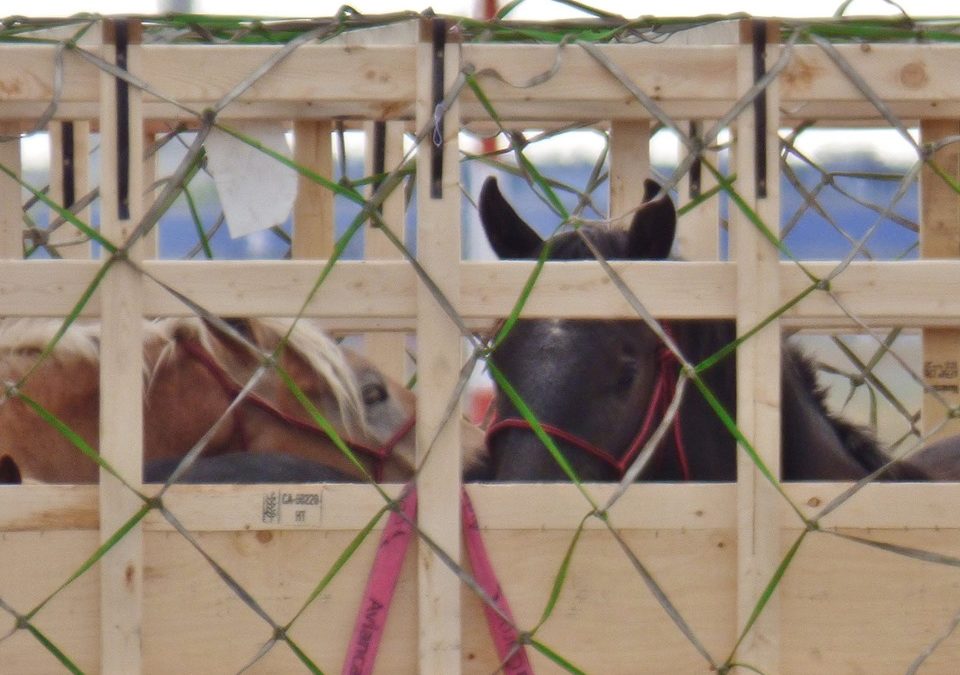
These horses are NOT shipped the way that show horses are shipped, instead they are crammed in wooden crates that are too small and shipped 3 and 4 to a crate, that is actually meant to hold just one horse.

Canadian and international shipping regulations are being broken.

Please help support this ground breaking lawsuit.

Read the full CTV story by clicking here.

T-SHIRTS IN SUPPORT OF HORSE RESCUE FUND 

LIMITED TIME OFFER FREE SHIPPING CANADA & USA 
BAN HORSE SLAUGHTER

FOR HUMAN CONSUMPTION OR ANY PURPOSE
DONATESHOP TO SAVE HORSES

Stolen Horse Sold for Hamburger

Stolen Horse Sold for Hamburger

This story is definitely re-post worthy.

This story is a reminder to all of us in Canada who live within a days drive of where slaughter plants are in Alberta, or Quebec, about how easy it would be for any of our horses to be snatched and slaughtered before we even knew they were missing.

Think about how far you live from either Alberta or Quebec, a days drive, 2 days drive or less?

So this story is pertinent to those who live ANY where in Canada, but especially in the provinces of Alberta and Quebec and neighbouring provinces, like British Columbia and Ontario.

Every horse owner within Canada or the United States needs to be aware that any horse can be stolen and unless your horse is branded,  there are not protocols in place at Canadian slaughter plants, to double check that a horse is stolen.  

There are also not any mandatory hold times after a horse is sold to a slaughter plant so horses are often slaughtered the same day they arrive at a slaughter plant.  

In other words, many Canadians could come home from work, or wake up in the morning to find that a horse or horses are missing, and  our horses could be slaughtered for human consumption without us being notified first.


Slaughtering horses in Canada is legal.

The practice has been banned in the United States but horses from the United States are routinely shipped to Canada and Mexico to be slaughtered.

There have been other well documented cases of horses disappearing and being slaughtered. 

Listen to Kim and Sargon’s story on Blue Sky Radio.

So what can you do to help bring this barbaric practice to a halt?

T-SHIRTS IN SUPPORT OF HORSE RESCUE FUND 

LIMITED TIME OFFER FREE SHIPPING CANADA & USA 
BAN HORSE SLAUGHTER

FOR HUMAN CONSUMPTION OR ANY PURPOSE
DONATESHOP TO SAVE HORSES

Pin It on Pinterest