No Results Found
The page you requested could not be found. Try refining your search, or use the navigation above to locate the post.

Originally posted July 2024.
Please scroll down for updates: April 2025 AND PLEASE…
Join us in lobbying for a new bill – and let’s not forget that slaughter is legal within Canada – yes, many now know that Canada allows for the live export of horses for the purpose of slaughter – but horses are routinely slaughtered within Canada for human consumption here and elese where.
Sign the fill in the blanks email form to let members of the Senate, the Prime Minister and your Member of Parliament know how you feel about both issues. (It takes 30 seconds.)
Recently on social media, we’ve noticed some advocates blaming Prime Minister Trudeau for the ongoing export of horses from Canada to Japan and other markets for the purpose of slaughter.
We are thankful that Prime Minister Trudeau and other Liberal MPs including MP Leah Taylor-Roy brought forward Bill C-355 – a bill to ban the export of horses by air for the purpose of slaughter. (BILL C-355 DETAILS HERE.)
Actually, that’s an understatement. We can not adequately express our thanks to all who were instrumental in bringing the bill forward and all who advocated for it. For example Jann Arden & EVERY single Liberal MP including PM Trudeau – every last one voted in favour of the bill to ban the export of horses for slaughter passing.
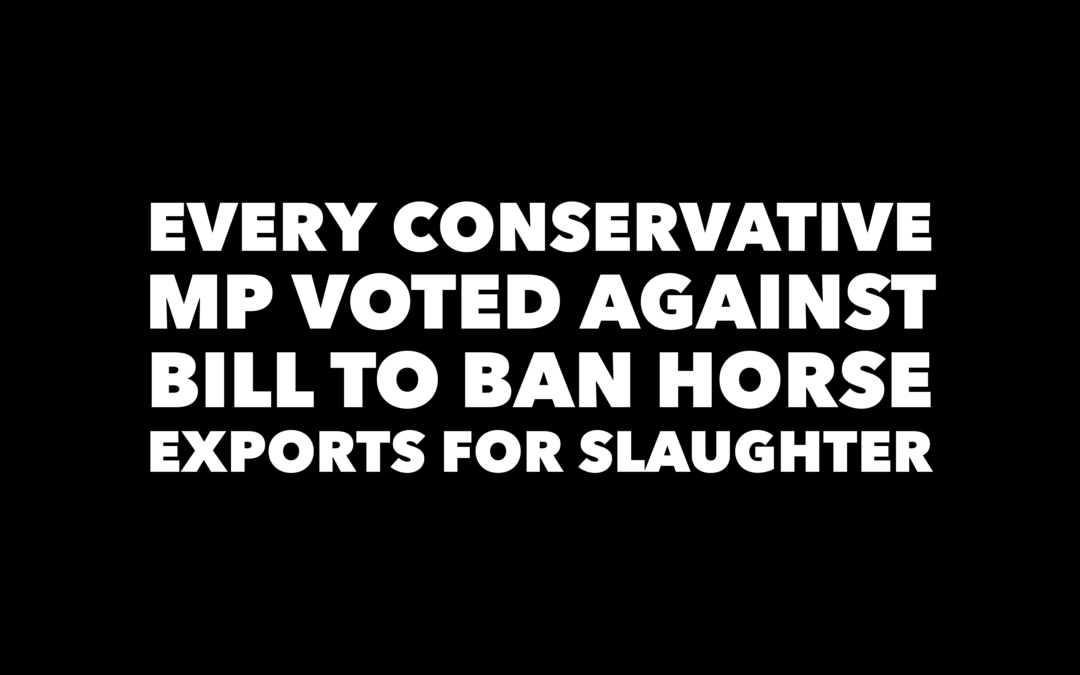
We are far less impressed with Conservatives who fought tooth and nail for this bill to NOT pass and who unanimously voted against it passing.
Yes, really, you can check the voting stats here.
Despite the fight Conservatives put up the Bill is now in the hands of the Senate and will be discussed further and voted on this fall.
In the meantime, what can we each do?
Reach out to Senators, if you are a Canadian citizen, every Senator represents you. SCROLL DOWN for a CALL TO ACTION.
You have the right to speak up and demand that they pay attention to what YOU want.
Even though not a single member of the Conservative Party was willing to vote in favour of Bill C-355 -- and every step of the way Conservatives fought to block Bill C-355 - designed to ban the export of horses for slaughter...
The Liberal Party persisted and Bill C-355 passed through Parliament - it was taken out of the hands of the Prime Minister Trudeau and Members of Parliament and it was put into the hands of Canadian Senators BUT...
UPDATE: Once a Federal election was called for April of 2025 the bill automatically came to an end in Senate.
So we start again... please keep reading.

The page you requested could not be found. Try refining your search, or use the navigation above to locate the post.

Help spread the word by sharing this email campaign with friends and family! You can also support the cause by donating—your contribution will help fund advertising efforts to raise awareness and push for change. Every action makes a difference!

Recently on social media, we’ve noticed some advocates blaming Prime Minister Trudeau for the ongoing export of horses from Canada to Japan and other markets for the purpose of slaughter.
We are thankful that Prime Minister Trudeau and other Liberal MPs including MP Leah Taylor-Roy brought forward Bill C-355 – a bill to ban the export of horses by air for the purpose of slaughter.
Actually, that’s an understatement. We can not adequately express our thanks to all who were instrumental in bringing the bill forward and all who advocated for it – including Jann Arden & EVERY single Liberal MP – every last one voted in favour of the bill passing.
We are far less impressed with Conservatives who fought tooth and nail for this bill to NOT pass and who unanimously voted against it passing.
Yes, really, you can check the voting stats here.
Despite the fight Conservatives put up the Bill is now in the hands of the Senate and will be discussed further and voted on this fall.
In the meantime, what can we each do?
Reach out to Senators, if you are a Canadian citizen, every Senator represents you. SCROLL DOWN for a CALL TO ACTION.
You have the right to speak up and demand that they pay attention to what YOU want.
Horses face harrowing journey to Japan
By: Jessica Scott-Reid
Posted: 2:01 AM CDT Saturday, Jul. 13, 2024
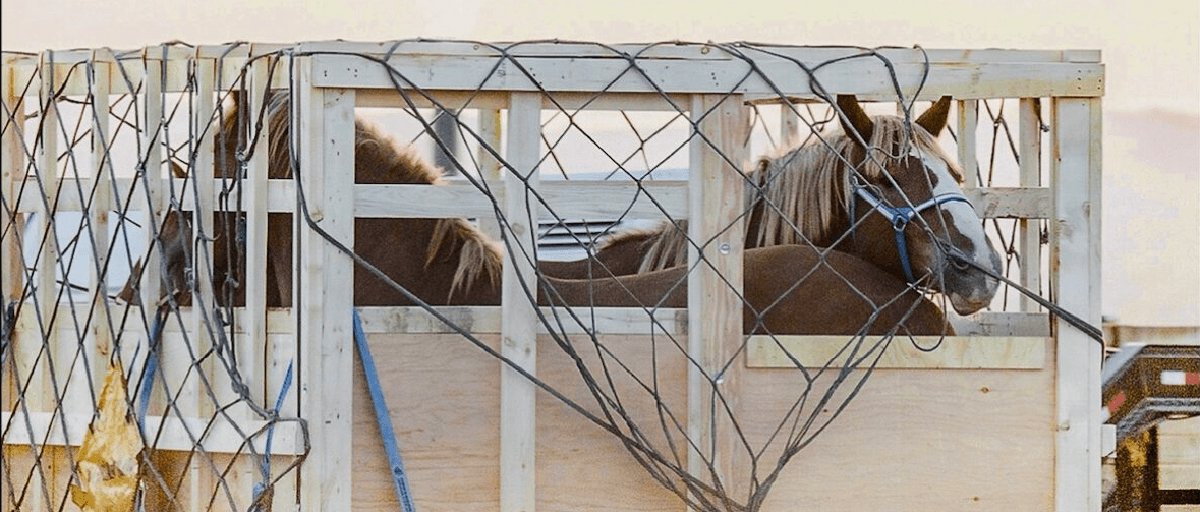
Years after the Liberal government promised to put an end to the cruel industry, (PLEASE SEE OUR NOTE ABOVE) horses packed into crates continue to be flown from airports in Winnipeg and Edmonton, all the way to Alaska, then on to Japan, without any relief along the way. And if that wasn’t bad enough, a new investigation — a first of its kind from on the ground in Japan — is now revealing that the gruelling travel conditions these animals are forced to endure are even worse than we thought. Advocates are now calling on the Canadian Food Inspection Agency to halt these shipments, as travel times routinely exceed legal limits.
Canadian animal law organization Animal Justice, along with Japanese animal protection group Life Investigation Agency, tracked four shipments of horses leaving Edmonton this past May and June, for Kansai and Kitakyushu airports in Japan. Canadian law prohibits transporting horses for over 28 hours without food, water and rest. “Yet official time records kept by the Canadian Food Inspection Agency generally end when the horses touch down in Japan, failing to account for the rest of the horses’ harrowing journey,” says Animal Justice in a statement.
Footage gathered in Japan shows horses being made to suffer through lengthy waits post-flight before being transported to a nearby quarantine facility. Total times from landing to reaching the feedlot ranged from four hours 20 minutes to an excessive 6.5 hours, delaying essential food, water and rest.
Upon further analysis of government records, Animal Justice, with the help of the Canadian Horse Defence Coalition, also determined “that all shipments from Winnipeg to Kitakyushu and Kansai airports over the last seven months appear to have gone over the 28-hour limit.”
When the horses do finally arrive in Japan, some were “visibly shaking with fear,” says Ren Yabuki, director of Life Investigation Agency, in the statement. “Horses were sprayed with disinfectant and workers forcefully unloaded them from trucks, yelling at them and banging metal rods.”
Danae Tonge, an organizer with Manitoba Animal Save, has witnessed first-hand horses being loaded up for export at Winnipeg’s Richardson International Airport.
“It’s horrifying,” she says, now knowing what awaits them when they land.
She says the process of getting horses off trucks, into crates and onto planes in Winnipeg takes a long time, hours, before they even take off.
“I’ve documented times when the horses arrive (at the airport) around 10 o’clock at night, then are unloaded, crated and then the flight doesn’t leave until five o’clock in the morning,” she says. “It’s shocking to now know how much worse it is, how much longer the journey is, and that every Winnipeg shipment is essentially breaking the law,” she says.
“It’s heartbreaking,” echoes Kaitlyn Mitchell, a lawyer with Animal Justice, who has joined Tonge in the past to document horses at the airport. “The vast majority of Winnipeggers and Canadians of all political stripes want to see this horrific practice end now,” she adds. “Any delay on the part of the CFIA will enable this industry to continue violating the law with impunity, and doom even more horses to suffer.”
Ater years of waiting on the Liberal government to fulfil its election promise to end the export of live horses for slaughter, advocates are now turning to the CFIA.
“We are urging the CFIA to look into this troubling situation and halt all horse exports for slaughter until the industry can guarantee that the shipments will comply with Canadian animal transport laws,” says Animal Justice.
While Bill C-355, an act to ban exporting horses by air for slaughter, currently sits before the Senate, it won’t be revisited until the fall as the Senate is now in recess. In the meantime, horses continue to be exported.
In an email to the Manitoba Co-operator, the CFIA reportedly states it is reviewing information provided by Animal Justice “and any followup activities will be in accordance with the agency’s compliance and enforcement policy.”
For advocates, this isn’t enough. More shipments of horses are expected over the summer.
“We need this to end,” says Mitchell.
“Now.”
Jessica Scott-Reid is a Winnipeg journalist and animal advocate. She is also on the board of directors of the Winnipeg Humane Society.
Even though not a single member of the Conservative Party was willing to vote in favour of Bill C-355 -- and every step of the way Conservatives fought to block Bill C-355 - designed to ban the export of horses for slaughter...
The Liberal Party persisted and Bill C-355 passed through Parliament - it was taken out of the hands of the Prime Minister Trudeau and Members of Parliament and it was put into the hands of Canadian Senators BUT...
UPDATE: Once a Federal election was called for April of 2025 the bill automatically came to an end in Senate.
So we start again... please keep reading.
The page you requested could not be found. Try refining your search, or use the navigation above to locate the post.
Help spread the word by sharing this email campaign with friends and family! You can also support the cause by donating—your contribution will help fund advertising efforts to raise awareness and push for change. Every action makes a difference!
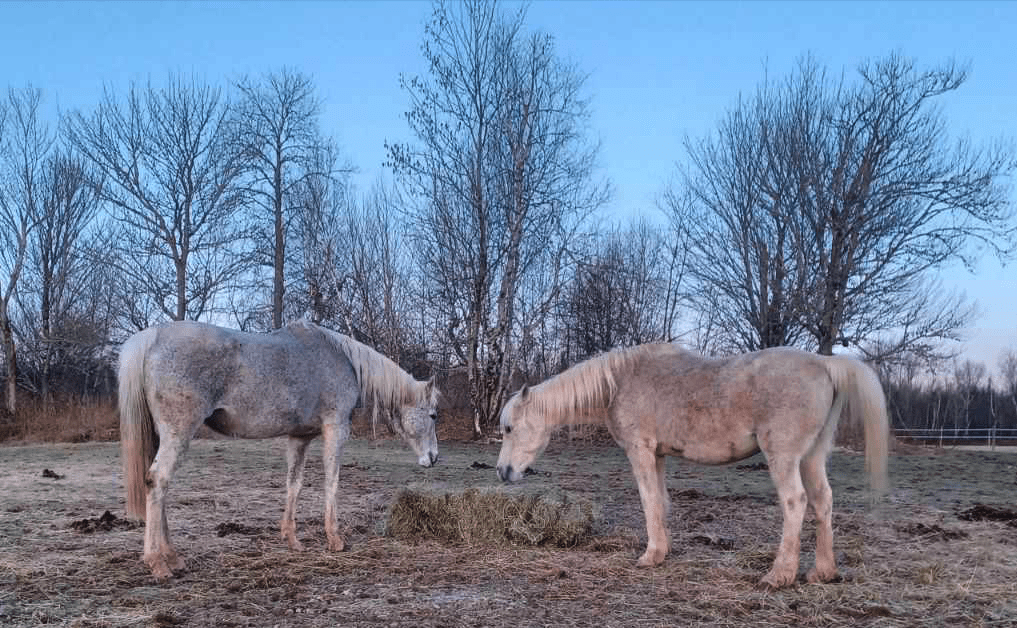

Del, an Arabian gelding on the left, Ice a thoroughbred mare on the right.
,July 12 , 2024:
For sometime I’ve been meaning to write a blog and social media posts about a farm in New Brunswick, Canada and a husband and wife team who have partnered with a non profit organization to help Canadian Veterans. Both are military veterans.
Their property has been developed to support veterans in various stages of healing and part of that process involves Equine Assisted Learning. (Horses, as our supporters know, are GREAT therapy.)
Additionally, they have been incredibly generous and regularly contributed to — and even developed — programs to help feed locals, including seniors and children.
Although the Veteran part of what they are so graciously doing is supported by a not for profit, the care of 8 rescued horses who otherwise would have ended up in danger of being slaughtered for meat, is NOT supported by the Veteran not for profit.
(Not for profit status in Canada is granted by the CRA and has very specific rules and obligations.)
The vetting, feeding, hoof care of 8 rescued horses in the care of the 2 veteran farm owners till now has been taken care of with their personal finances.
The last two horses they took in are in need of veterinarian care including teeth, vaccines, and of course regular farrier care – and will add an extra expense to the hay and feed bill for this winter.
In an ideal world they would be able to take in more horses instead of constantly having to turn away horses at risk of being slaughtered – including requests from rescues and sanctuaries who are at capacity.
But for now they are seeking financial assistance to help with their latest 2 intakes.
Ice a thoroughbred mare on the left and Del an Arabian gelding on the right.
The 2 most recent horses were loved but unfortunately their owner lost her home and was unable to take the horses with her.
Temporarily Ice and Del were left with some hay and water but they were found loose multiple times and becoming a hazard on the road.
Del, an Arabian gelding, is 20 plus years of age and finding a home for a horse of that age is never an easy task.
The second horse, a mid-teens thoroughbred named Ice, is also a hard to place horse because of a history of issues including re-occurring abscesses which are evident on her hooves.
Neither had been vet checked in some time or vaccinated in the recent years.
Both are safe, and the owners of Philomena Farms are committed to their care but financial support with these two would help them take on even more horses who are at risk of being shipped to slaughter.
As always you can ear mark your donation specifically for these horses…
Or any other part of our mission.
Just send us a note after you’ve donated and
we’ll make sure it’s applied to whoever you want to help!
The page you requested could not be found. Try refining your search, or use the navigation above to locate the post.
Help spread the word by sharing this email campaign with friends and family! You can also support the cause by donating—your contribution will help fund advertising efforts to raise awareness and push for change. Every action makes a difference!

June 10, 2024:
We continue to hear that Bouvry in Fort MacLeod has closed.
That rumour, a misinterpretation of a post by a well known and much respected by us group persists. The main FEEDLOT – which is not adjacent to the plant has been closed for some months now.
The plant slaughtered horses again, Thursday May 30, 2024.
We know that the plant has been up for sale, several times we’ve heard that the plant has sold, or that “only one signature was needed for the deal to be done”.
Those rumours have persisted since late 2022, increasing dramatically since the end of 2023.
Several rescues in Alberta and British Columbia late last week stated that the plant has sold.
We’ve since heard the same from a very reliable source.
From the same source we’ve heard that the new owners were considering NOT continuing with the slaughtering of horses…
BUT when they “crunched the numbers, they changed their minds and will continue to slaughter horses as well as cattle”.
With very special thanks to a lawyer in Alberta who wishes to remain annoymous we do know that Bouvry has plead not guilty to charges laid against them by the Canadian Food Inspection Agency.
Charges were laid July 17th, 2023 based on activities by Bouvry Exports Calgary, LTD, in 2021.
We describe the charges as animal cruelty and health food safety related.
You can learn more here.
Thanks to the same lawyer we know that the trial dates are January 6 to 17, 2025 in Fort MacLeod, Alberta.
These charges could be resolved between now and then – we’ll do our best to keep you up to date.
We didn’t really start out with the idea of fund raising, we started out with the idea to help educate Canadians and others that horse slaughter is alive and well in Canada (and other countries).
We were frustrated that when someone asked us questions about the horse slaughter industry that we didn’t have a spot to send them to learn more.
We found ourselves copying and pasting press articles into private messages and onto social media posts, and constantly writing and re-writing – and copying and pasting the same things — so https://banhorseslaughter.com and the accompanying blog were created.
Our team has years of experience taking in horses, attending to their needs, and carefully re-homing. Since inception that work has quietly continued.
Additionally we’ve supported and promoted many rescues – and many of the BHS team are responsible for establishing a registered not for profit.
Each organization has a different mission statement.
Here at Ban Horse Slaughter – our main mission is exactly that, to ban the slaughter of horses within Canada and the export of horses for that same purpose — and you’ll notice that we are not shy about locking arms with American advocates. After all many of the horses slaughtered in Canada are imported from the USA.
We work hard at consistently funding advertising on social media platforms – and continuing on that theme we’d love to fund bill boards.
We believe that if more Canadians were aware about the fact that horse slaughter exists, there would be an even greater uproar and that we can make the slaughtering of horses illegal – like it is in the USA and other countries.
We’ve been lucky enough to have room to continue to take in and re-home horses entering the slaughter pipeline – although again that was never meant to be our main focus — in the last 12 months recently we’ve been able to find a handful of experienced, amazing, kind, generous foster homes (in British Columbia and Alberta) to do the same.
When it comes to all of our work, we’ve been incredibly lucky to have generous and consistent sponsorship from individuals across Canada, the USA, the UK and Australia. To our supporters — thank you — we can’t do what we do without support.
Additionally our board members and foster homes have dug deep time and again to continue and expand the work we do – not only with countless hours but with funds.
Thank you to all who have supported, and continue to support.
If anyone has any questions please don’t be shy… Reach out here.
The page you requested could not be found. Try refining your search, or use the navigation above to locate the post.
Help spread the word by sharing this email campaign with friends and family! You can also support the cause by donating—your contribution will help fund advertising efforts to raise awareness and push for change. Every action makes a difference!

ABOUT THE AUTHOR
As a long-practicing registered professional biologist (RPBio) in British Columbia, I have had a wide range of experience in wildlife research, environmental impacts, cumulative effects analysis, and management/conservation issues in western Canada. I have headed numerous research projects, including on Chilcotin free-roaming horses, mammal inventory in Yoho National Park, grizzly bears, black bears, western toads, mountain goats, Roosevelt elk, spirit (Kermode) bears, and other species. I am well familiar with the ecology of the Alberta Foothills having mapped and studied grizzly bear habitat in Kananaskis Country for three years with Dr. Stephen Herrero, and for producing a report for Alberta Fish and Wildlife on the history of the grizzly bear in K-Country. In Alberta, I was also a waterfowl researcher on the first environmental impact study of the Athabasca Tar Sands (Syncrude), and a wildlife researcher on a gas pipeline from Chief Mountain Alberta to Trail, British Columbia.
I have conducted considerable ungulate research, including on barren-ground caribou, bighorn sheep, Roosevelt elk, and mountain goats. In 2015/2016, I carried out a professional review of feral horse management in Alberta.
Over the past 20 years, my research on wild horses in the BC Chilcotin has included field research on habitat use and response to wildfires, as well as genetic studies. I have also worked with the Xeni Gwet’in-Tsilhqot’in Nation on a wild horse management plan and guidelines for wildlife and wild horse tourism viewing. I recently published a book on my wild horse research titled The Wild Horses of the Chilcotin: Their History and Future, which won the 2024 Basil Stuart-Stubbs Prize for the best scholarly book by a Canadian author on a BC subject. It was given a starred review by the US Booklist for a work judged to be outstanding in its genre.
I have produced over 100 wildlife reports, including a number of publications in peer- reviewed journals. I have produced or co-authored three reports on Chilcotin wild horses and have been a co-author of two peer-reviewed scientific papers related to wild horses, one on the diet of Chilcotin wolves and the other on the spread of the domestic horse across the Americas, which won the prestigious 2024 AAAS Newcomb Cleveland Prize for outstanding contribution to science.
Cover Photo by Duane Star Photography

The page you requested could not be found. Try refining your search, or use the navigation above to locate the post.
The Bouvry slaughter plant in Alberta is currently closed, though whether that closure is temporary or permanent remains unclear. The plant in Quebec continues to operate.
In British Columbia, independent butchers report receiving requests to slaughter horses alongside other livestock. To some, money is money — and an animal is simply meat so slaughter continues to thrive in the west.
Ban Horse Slaughter continues to intervene directly — purchasing horses from kill buyers and from pens operated by First Nations Bands before they are shipped for slaughter. With the help of a foster network, we place horses into safe, permanent homes.
The costs extend well beyond purchase — transport, feed, veterinary care, and ongoing support.
Ban Horse Slaughter is 100% volunteer-run.
0% goes to salaries.
If you would like to help us continue this work:
The page you requested could not be found. Try refining your search, or use the navigation above to locate the post.
Help spread the word by sharing this email campaign with friends and family! You can also support the cause by donating—your contribution will help fund advertising efforts to raise awareness and push for change. Every action makes a difference!