No Results Found
The page you requested could not be found. Try refining your search, or use the navigation above to locate the post.


Bill C-355 – a bill to ban the export of horses from Canada for the purpose of slaughter by air or to be fattened for slaughter passed through Parliament and is now in the hands of Canada’s Senators.
Senators are appointed by the Governor General at the suggestion of the Prime Minister and serve until they choose to retire — or until they reach the age of 75.
Currently, there are Senators in the Canadian Senate serving because of three different Prime Ministers including Conservative PM Harper.
Bill C-355 was “read” in the Senate on Tuesday, May 21, 2024.
The Second Reading and first real discussion about the bill in the Senate happened on Tuesday, May 28, 2024, before the summer recess.
The time allotted for that discussion was fully used and now horse advocates across Canada are anxiously waiting for the Second Reading debate to continue.
Watch the Second Reading here.
P.S. Scroll down to read a transcript of the Hon. Pierre J. Dalphond’s speech before the Senate – AND a CALL TO ACTION. (AKA what YOU can do to make a difference.)
Oh, and one more note.
Sadly, the chairman of the Senate AG Committee, Senator Rob Black does not appear to be in favour of Bill C-355. Calls to his office have gone unanswered.
Senator Black, if you or your staff would like to go on the record with your views – and return one of many calls to your office that have gone unanswered – please call Marie @ 250 801 8231.
Before we publish our next blog post we’d like to see if you feel the same way you did in May before new evidence regarding the number of horses who have died in the last year due to being transported by air to slaughter has come to light.
Based on the questions you asked during the continuation of the Second Reading on November 7, 2024. We have our answer. You are opposed to Bill C-355.
We’ll have another post featuring the questions Senator Rob Black asked Senator Dalphond (along with others who support the bill) soon – along with responses from various experts.
Prohibition of the Export of Horses by Air for Slaughter Bill
Bill to Amend—Second Reading—Debate Adjourned
Hon. Pierre J. Dalphond moved second reading of Bill C-355, An Act to prohibit the export by air of horses for slaughter and to make related amendments to certain Acts.
He said: Honourable senators, I am pleased to rise to begin the debate at second reading of Bill C-355, an Act to prohibit the export by air of horses for slaughter and to make related amendments to certain Acts.
This title is a very accurate description of the content of the bill, which sets out only eight provisions over three pages, one of which is dedicated to a long preamble.
(1650)
In other words, this private member’s bill, if adopted by the Senate, will do just one thing:
Prohibit people from putting horses on planes for the purpose of being slaughtered or fattened for slaughter in another country, primarily Japan.
Fresh horsemeat is actually a prized delicacy in Japan. Known as sashimi, the meat must be raw, so it must be eaten soon after slaughter.
One of the main suppliers of live horses to the Japanese market is Canada.
Currently, horses are exported from airports in Winnipeg, Calgary and Edmonton, to which they have been transported by trailer from a feedlot just hours before.
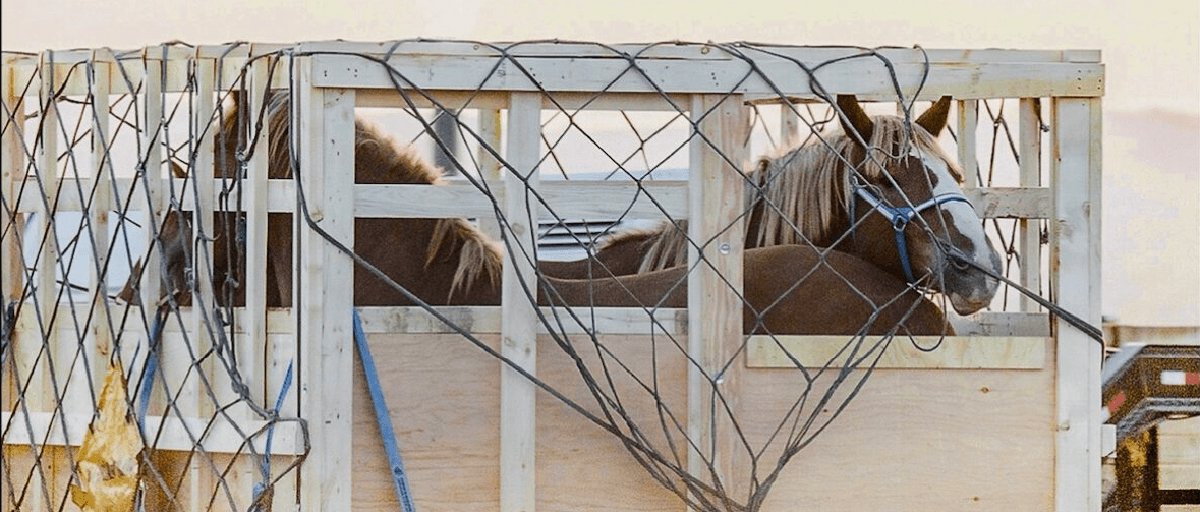
At the airport, they’re crammed into wooden cages and flown to Japan.
As we all know, a trip from Winnipeg to Tokyo takes many hours, even if it’s non-stop.
That’s in addition to the road trip and waiting time at the airport and on the plane.
The premise of this bill is that this process subjects horses to dozens of hours of unnecessary stress and pain, and that it must end.
[English]
My speech will be divided as follows:
one, the origin of this bill and its legislative history;
two, the content of the bill;
three, the wide support for it among Canadians;
four, the impact on Canadian agriculture;
five, the scientific and veterinary cases for the bill;
six, Canadians’ special relationship with horses;
seven, the main arguments of those opposing; and finally,
eight, the next steps for the bill.
Before I proceed further, I want to make a declaration.
My spouse and I both love horses and are the proud owners of a beautiful, black Friesian horse named Victoria, who is beginning to win prizes in dressage competitions. So I love horses. Maybe that makes me “woke.”
My interest in the issue of the live export of horses for slaughter overseas started with reading a piece in The Globe and Mail, written by columnist Gary Mason, published on March 1, 2023, entitled “The unconscionable horse slaughter we need to end now.”
I was shocked to read about up to four horses being confined in small wooden crates for long flights and going without food and water for over 24 hours.
Further research by my team revealed that during the 2021 federal election, the Liberal Party announced that, if re-elected, their government would prevent shipping horses to Japan by air for slaughter.
After realizing that the Minister of Agriculture and Agri-Food was not moving in a timely way, I decided to work on a Senate bill to prompt action on this issue.
On June 21, 2023, as some of you might remember, I introduced Bill S-270, entitled the “Horse Protection Act.”
At about the same time, and maybe not truly a coincidence, Liberal MP Tim Louis announced in a statement in the other place that he intended to table a private member’s bill on live horse export by air for slaughter in September 2023.
I contacted MP Louis and offered to work collaboratively to achieve our shared goal. On September 19, 2023, he introduced Bill C-355.
The same day, the Prime Minister backed this bill.
A spokesperson for the Minister of Agriculture and Agri-Food said that the department would work with MP Louis “every step of the way” during the passage of this bill. Subsequently, MP Louis was able to place his bill on the priority list of private members’ bills up for scheduled debate and decisions in the House of Commons.
His bill completed second reading on January 31, while being studied and amended by the Agriculture Committee and adopted on division on May 9.
Meanwhile, on March 21, I let my bill drop from the Order Paper to avoid the potential point of order that we saw with the two wildlife captivity bills, Bill S-241 and Bill S-15.
I move now to my second point — the content of the bill before us.
Essentially, Bill C-355 is animal protection legislation that targets a specifically cruel practice: the export of live horses by air for slaughter.
This three-page bill targets the stress and cruelty of these long and gruelling flights to Japan, according to scientific and veterinary information.
Let’s be clear, the bill will not affect the domestic slaughter of horses or the export of horse meat.
The bill prohibits a person from exporting a horse by air unless they have provided the Minister of Agriculture and Agri-Food with a written attestation that, to the best of their knowledge, the horse is not being exported for slaughter or fattened for slaughter.
As well, it creates an offence to make a false or misleading statement on this subject.
Contravention of the new act would be subject to similar penalties as those found in the Health of Animals Act, a federal statute for regulating livestock in place since 1990.
However, Bill C-355 is written as a stand-alone bill specific to the practice we’re trying to ban.
Furthermore, Bill C-355 will come into force 18 months after Royal Assent to allow horses currently being raised for food to work through the system.
The intent is to strike a balance between practical considerations and ending this practice as soon as possible.
In the other place, the Standing Committee on Agriculture and Agri-Food amended the bill to remove any administrative burdens on pilots and Canada Border Services Agency, or CBSA, officials as well as to prevent adding red tape for other sectors of the equine industry, such as horses travelling for sport.
I now move to my third point — the strong support of Canadians for ending the live export of horses for slaughter overseas.
A key factor in the bill’s origins is determined grassroots support.
Last year, singer-songwriter Jann Arden, patron of the Canadian Horse Defence Coalition, said:
“Since 2006, tens of thousands of terrified horses have been crammed into shoddy wooden crates and flown 8,000 km to their demise, enduring turbulence, thirst and hunger, and abject fear.”
To say this practice is inhumane would be an understatement. Canadians want this to end.
Ms. Arden has a good read of Canadians’ feelings about it.
For example, on June 22, 2021, MP Nathaniel Erskine-Smith presented a [member of Parliament sponsored] petition to the House of Commons on this subject with over 77,000 signatures.
On February 13, 2023, MP Alistair MacGregor presented another such petition to the other place with over 36,000 signatures. Those petitions indicate the importance to Canadians of banning live exports of horses overseas for slaughter.
Moreover, opinion polls also confirm this fact.
An online survey conducted in 2021 by Research Co. revealed that 54% of Canadians then strongly opposed the export of Canadian horses for slaughter abroad and another 13% moderately opposed.
Only 22% strongly or moderately supported this practice.
The highest level of strong opposition was in Alberta, with 61% strongly opposed plus 13% moderately opposed.
Like Albertans, I love horses.
Also worth mentioning is that the highest level of opposition was found among persons who voted Conservative in 2019 — at 69%.
A similar survey conducted by the same firm from April 3 to April 5 of this year showed that 68% of Canadians agree with banning the export of horses for slaughter.
On a regional basis, support for a ban was highest in Alberta, at 78%;
followed by B.C., at 71%;
Atlantic provinces, at 70%;
Ontario, at 68%;
Quebec, at 65%;
and Saskatchewan and Manitoba, at 64%.
The level of support for a ban among those who voted Conservative in the previous election decreased to 65%, while 74% of those who voted NDP and 73% of those who voted Liberal were in support of the ban.
Thus, we can see that support for this policy is strong across the country and among voters for the major parties running across Canada.
Also worth mentioning is that among Indigenous and First Nations peoples in Canada, 71% agree that this practice should be banned.
My fourth point is about the impact on the industry that will likely be affected by the bill.
In Canada, the live export of horses for slaughter is a limited business and relatively new.
Many of these horses are large draft breeds, such as Clydesdales, which are famous from Budweiser commercials, and Percherons, which are well known in Quebec.
In 1965, the then Minister of Trade and Commerce responded to a question on the Order Paper regarding horse exports to Europe by revealing that there had been only one shipment of live horses for slaughter to Europe in the previous 10 years, consisting of 330 horses shipped in 1964. So in the 1960s, this was not a real trade.
The first record of Japanese imports of live horses from Canada is found in the United Nations Commodity Trade Statistics Database and dates to 1991, when Japan imported 34 live horses from Canada, valued at USD57,000.
Let me now refer to statistics on the evolution of this trade in Canada.
Since 2012, Statistics Canada has provided data on Canadian exports of horses destined for slaughter by country of import.
A review of the data reveals that in 2012 Canada exported almost 1,200 horses to Japan for slaughter, worth almost $6 million.
In 2014, the number of horses reached a peak of 7,100 live horses exported to Japan for slaughter.
In 2015-16, that number decreased by about 20%, with about 5,800 horses each year — down from the over 7,000 the year before.
The decrease continued afterwards.
By 2019, the number of horses exported to Japan fell to 2,800 — a number never reached again.
In 2022-23, the number seems to have stabilized at about 2,500 horses per year.
According to Statistics Canada, these exports were worth about $19 million in each of these two years.
By comparison, Canada exported about $25 million worth of horsemeat during each of these years.
As I said, Bill C-355 would come into force 18 months after Royal Assent to allow a transition for affected businesses by allowing horses currently being raised for food to work through the system.
These businesses can adjust, if they wish, to participate in the domestic slaughter of horses and the export of horsemeat.
However, the export of live horses for sashimi — a cruel practice — will not be possible.
Statistics Canada also provides data on the export of horsemeat, including that of mules and donkeys. Interestingly — as I said — the value in Canadian dollars of this meat export has always exceeded the value of the export of live horses, but it is also on a drastic downward path in value and quantity.
I repeat: This bill will not end the export of horsemeat.
Senators, I turn now to the scientific and veterinary reasons for this bill.
Essentially, animal protection legislation requires an analysis at the intersection of biological science and ethics.
This science can neither be ignored nor dismissed as woke.
A key ethical point is that, with horses, we are dealing with sentient creatures, meaning they have perceptions and feelings.
Horses are not property like tables or chairs.
In 1780, the British philosopher Jeremy Bentham wrote a book called ‘An Introduction to the Principles of Morals and Legislation’.
It’s part of the curriculum at Oxford.
Prior to this milestone, many European philosophers and religious thinkers viewed animals as unworthy of moral consideration because animals didn’t, they supposed, have souls.
However, Bentham wrote of animals, “The question is not Can they reason? or Can they talk? but Can they suffer?“
Thus, Bentham and scientists like Charles Darwin helped bring Western thinking closer to Indigenous wisdom.
As we’ve heard in some of our debates, many First Nations view animals as “all our relations,” understanding that life forms are interconnected and interdependent.
Taking a similar perspective, in 1871, Charles Darwin wrote:
. . . the difference in mind between man and the higher animals, great as it is, certainly is one of degree and not of kind.
Senators, what do science and veterinary medicine tell us about the ethics of shipping live horses to Japan for slaughter?
During air transport, horses — which [WHO] are easily panicked and have a strong flight response — become stressed and suffer due to the loading process and the loud, sudden and unfamiliar noises of aircraft of up to 140 decibels.
They suffer from close confinement in crates with unfamiliar and terrified horses.
Having a high centre of gravity, they also have difficulty balancing during takeoff, turbulence and landing, sometimes resulting in falls and injury.
In February, 34 veterinarians and animal welfare experts wrote to the House Agriculture Committee in support of Bill C-355.
I will cite a long passage of the brief:
The journey by land and air from remote feedlots in western Canada to feedlots in Japan generally takes more than 24 hours, during which time the animals are denied food, water, and rest. . . .
Horses travelling by air can experience moderate to severe suffering in many forms, including anxiety, fear, pain, exhaustion, physical discomfort, auditory discomfort, hunger, thirst, and panic.
There is strong scientific evidence to support banning this practice for animal welfare reasons.
It is important to be clear that the conditions under which horses are exported for slaughter – and, by extension, the associated risks to their health and wellbeing – are markedly different from sport horses transported by air for other purposes.
This is because horses transported for slaughter
(a) are subjected to higher stocking densities and are confined in smaller spaces,
(b) are provided less supervision and intervention during flights as well as medical care before, during and after transport,
(c) are subjected to different handling styles prior to and during transport and are denied access to water,
(d) are more likely to be confined with other unfamiliar and potentially incompatible horses, and
(e) have less training and habituation to travel.
I’m tempted to say that horses which compete in Olympic competitions and other sporting events travel first class, but not those travelling to Japan to become sashimi.
Colleagues, this is the main case for Bill C-355.
I turn now to Canadians’ special relationships with horses, which, though they are much larger, are often treated as companion animals such as dogs and cats.
We don’t have a horse in our house, but we do have two dogs.
As MP Louis noted, Canadians rely on horses for transportation and labour.
Horses have also given us friendship and service in times of war, with nearly 25,000 horses and mules serving our country overseas during World War I.
We know the iconic black horses of the RCMP and celebrate Canada’s Sports Hall of Fame members Big Ben and Northern Dancer.
In fact, not only do we have a special relationship with horses, but they have a special relationship with North America.
It is a misconception that wild horses in Canada are an invasive species introduced by Europeans.
In fact, horses evolved in North America before crossing an ancient land bridge to Asia and going extinct in the Americas over 10,000 years ago, at the end of the last ice age.
They were brought back to North America by colonizers from Europe.
Senators, horses came home, and their strength and loyalty built our country.
We are justified in according special treatment to these gentle creatures who are so dear to us.
We are therefore looking to ban a particularly cruel and unnecessary practice with Bill C-355.
This is done in the same spirit as the Harper government’s enactment in 2015 of an animal cruelty offence specific to service animals used in law enforcement, including horses.
That bill was named Quanto’s Law, in honour of an Edmonton German shepherd police dog killed in the line of duty.
Colleagues, before concluding, I will quickly address five arguments you may hear against this bill during this upcoming debate.
The first is the suggestion that this bill initiates a slippery slope with respect to other animal use industries.
However, we are dealing with a bounded and particularly cruel practice.
This bill does not criticize the slaughter or consumption of horses or livestock generally and deals with one issue: the cruelty of air transport in a particular context related to the biological characteristics of horses.
Banning specific cruel and unnecessary practices is not a slippery slope, but rather a stairway to heaven.
A second potential objection is that the bill does not end the export of horses by air for all reasons, so what’s the difference?
As I outlined, veterinarians and other experts have identified major practical differences.
A third potential objection is that the bill is arbitrary or based only on emotions.
For my part, empathy with horses should not be dismissed; also, emotions are not arbitrary.
Our two species have a close and important relationship of affection and reciprocity.
As I explained, we also have rational scientific evidence of cruelty with respect to the transport by air of horses to Japan for slaughter.
A fourth potential objection is that some of the breeders of horses for export are Métis, a matter raised by the Conservative Party and a witness in the other place.
Our committee will no doubt hear more about that.
However, I understand that the practice of breeding and shipping live horses by air for slaughter in Japan is a relatively recent and non-traditional practice in Canada.
Again, businesses can adjust to export horsemeat, just not the live horses intended to be served as sashimi.
It is also my understanding that the same ethical and legal considerations would apply equally to all Canadians in terms of any interest or prohibition regarding shipping horses by air to Japan for slaughter.
On a final and related point, I understand that one witness from the horse-producing sector preferred to appear anonymously at committee in the other place due to fear of harassment by activists.
As with all bills, we should judge Bill C-355 on its merits, and the voices of stakeholders should be heard in a respectful way.
Disagreement is part of democracy, but everyone should respect the norms of civil dialogue as well as free expression, and treat their fellow citizens with respect.
I trust our Senate committee will safeguard and uphold these values in our study.
Colleagues, I conclude with a few remarks on the process. Bill C-355 is a House of Commons private member’s bill. I’m glad that all groups in our chamber are increasingly acknowledging that, as an appointed chamber, the Senate has a duty to properly review and vote on these bills passed by MPs.
On the one hand, these bills have sometimes faced unreasonable and arduous processes in the Senate, with attempts and even successes by some senators to exercise veto-like powers over them by preventing votes through procedural tactics and repetitive adjournments to create delays.
Professor Andrew Heard has called this the Senate’s “. . . pocket veto.” Two bills currently facing challenges in our process are the Green Party’s Bill C-226, regarding environmental racism, sponsored in this chamber by Senator McCallum; and the Bloc Québécois’s Bill C-282, regarding supply management, sponsored by Senator Gerba.
On the other hand, our process for these “C” bills sometimes lacks due diligence.
This month, a private member’s bill, Bill C-275, passed second reading without a sponsor or critic’s speech or any debate.
That was an interesting, fast-tracked second reading.
This is all the more surprising in that, according to the emails we have received over the last few months, it seems to be a controversial bill.
Such a Senate process cannot be justified to Canadians.
To bring integrity, fairness, transparency and due diligence to our process for House of Commons private members’ bills, in 2020, former senator Murray Sinclair and I proposed rule changes.
Our package was based on a 2014 proposal of a former Speaker, the late senator Pierre Claude Nolin of the Conservative caucus, former senator Serge Joyal of the Senate Liberals and former senator Vernon White, then a member of the Conservative caucus and later the Canadian Senators Group. It’s time to consider these proposals again.
Their proposal in the Forty-first Parliament was contained in the fifth report of the Rules Committee, adopted by members not on consensus, but with a vote of nine to six. Perhaps we should revisit that initiative in the fall.
In any event, we should be vigilant and ensure fair and responsible treatment of House of Commons private members’ bills in this place. It is a question of respect for MPs, for Canadians and for Canadian democracy.
They’re elected, and they speak on behalf of the Canadians who elected them.
Therefore, I am speaking against horse trading in more than one way.
I’m confident, in the process of due diligence, that Bill C-355 presents a strong case for protecting horses from the cruel practice of exporting them live and by air to Japan for slaughter. Therefore, colleagues, I ask for your support.
Thank you. Meegwetch.

Even though not a single member of the Conservative Party was willing to vote in favour of Bill C-355 -- and every step of the way Conservatives fought to block Bill C-355 - designed to ban the export of horses for slaughter...
The Liberal Party persisted and Bill C-355 passed through Parliament - it was taken out of the hands of the Prime Minister Trudeau and Members of Parliament and it was put into the hands of Canadian Senators BUT...
UPDATE: Once a Federal election was called for April of 2025 the bill automatically came to an end in Senate.
So we start again... please keep reading.
Recently on social media, we’ve noticed some advocates blaming Prime Minister Trudeau for the ongoing export of horses from Canada to Japan and other markets for the purpose of slaughter.
We are thankful that Prime Minister Trudeau and other Liberal MPs including MP Leah Taylor-Roy brought forward Bill C-355 – a bill to ban the export of horses by air for the purpose of slaughter. (BILL C-355 DETAILS HERE.)
Actually, that’s an understatement. We can not adequately express our thanks to all who were instrumental in bringing the bill forward and all who advocated for it. For example Jann Arden & EVERY single Liberal MP including PM Trudeau – every last one voted in favour of the bill to ban the export of horses for slaughter passing.
We are far less impressed with Conservatives who fought tooth and nail for this bill to NOT pass and who unanimously voted against it passing.
Yes, really, you can check the voting stats here.
Despite the fight Conservatives put up the Bill is now in the hands of the Senate and will be discussed further and voted on this fall.
In the meantime, what can we each do?
Reach out to Senators, if you are a Canadian citizen, every Senator represents you. SCROLL DOWN for a CALL TO ACTION.
You have the right to speak up and demand that they pay attention to what YOU want.

The page you requested could not be found. Try refining your search, or use the navigation above to locate the post.

Help spread the word by sharing this email campaign with friends and family! You can also support the cause by donating—your contribution will help fund advertising efforts to raise awareness and push for change. Every action makes a difference!
Thank you, Jann Arden, for your unwavering commitment to advocating for the protection of horses.
Your efforts, particularly in helping to ban the live export of horses for slaughter, have made a tremendous difference.
(That is an understatement - where would this cause be without you?)
It's inspiring to see you continue to use your platform to raise awareness, and your recent features in the press are a testament to the importance of this cause.
Your dedication is deeply appreciated!


Even though not a single member of the Conservative Party was willing to vote in favour of Bill C-355 -- and every step of the way Conservatives fought to block Bill C-355 - designed to ban the export of horses for slaughter...
The Liberal Party persisted and Bill C-355 passed through Parliament - it was taken out of the hands of the Prime Minister Trudeau and Members of Parliament and it was put into the hands of Canadian Senators BUT...
UPDATE: Once a Federal election was called for April of 2025 the bill automatically came to an end in Senate.
So we start again... please keep reading.
Recently on social media, we’ve noticed some advocates blaming Prime Minister Trudeau for the ongoing export of horses from Canada to Japan and other markets for the purpose of slaughter.
We are thankful that Prime Minister Trudeau and other Liberal MPs including MP Leah Taylor-Roy brought forward Bill C-355 – a bill to ban the export of horses by air for the purpose of slaughter. (BILL C-355 DETAILS HERE.)
Actually, that’s an understatement. We can not adequately express our thanks to all who were instrumental in bringing the bill forward and all who advocated for it. For example Jann Arden & EVERY single Liberal MP including PM Trudeau – every last one voted in favour of the bill to ban the export of horses for slaughter passing.
We are far less impressed with Conservatives who fought tooth and nail for this bill to NOT pass and who unanimously voted against it passing.
Yes, really, you can check the voting stats here.
Despite the fight Conservatives put up the Bill is now in the hands of the Senate and will be discussed further and voted on this fall.
In the meantime, what can we each do?
Reach out to Senators, if you are a Canadian citizen, every Senator represents you. SCROLL DOWN for a CALL TO ACTION.
You have the right to speak up and demand that they pay attention to what YOU want.
The page you requested could not be found. Try refining your search, or use the navigation above to locate the post.
Help spread the word by sharing this email campaign with friends and family! You can also support the cause by donating—your contribution will help fund advertising efforts to raise awareness and push for change. Every action makes a difference!

Recently on social media, we’ve noticed some advocates blaming Prime Minister Trudeau for the ongoing export of horses from Canada to Japan and other markets for the purpose of slaughter.
We are thankful that Prime Minister Trudeau and other Liberal MPs including MP Leah Taylor-Roy brought forward Bill C-355 – a bill to ban the export of horses by air for the purpose of slaughter.
Actually, that’s an understatement. We can not adequately express our thanks to all who were instrumental in bringing the bill forward and all who advocated for it – including Jann Arden & EVERY single Liberal MP – every last one voted in favour of the bill passing.
We are far less impressed with Conservatives who fought tooth and nail for this bill to NOT pass and who unanimously voted against it passing.
Yes, really, you can check the voting stats here.
Despite the fight Conservatives put up the Bill is now in the hands of the Senate and will be discussed further and voted on this fall.
In the meantime, what can we each do?
Reach out to Senators, if you are a Canadian citizen, every Senator represents you. SCROLL DOWN for a CALL TO ACTION.
You have the right to speak up and demand that they pay attention to what YOU want.
Horses face harrowing journey to Japan
By: Jessica Scott-Reid
Posted: 2:01 AM CDT Saturday, Jul. 13, 2024
Years after the Liberal government promised to put an end to the cruel industry, (PLEASE SEE OUR NOTE ABOVE) horses packed into crates continue to be flown from airports in Winnipeg and Edmonton, all the way to Alaska, then on to Japan, without any relief along the way. And if that wasn’t bad enough, a new investigation — a first of its kind from on the ground in Japan — is now revealing that the gruelling travel conditions these animals are forced to endure are even worse than we thought. Advocates are now calling on the Canadian Food Inspection Agency to halt these shipments, as travel times routinely exceed legal limits.
Canadian animal law organization Animal Justice, along with Japanese animal protection group Life Investigation Agency, tracked four shipments of horses leaving Edmonton this past May and June, for Kansai and Kitakyushu airports in Japan. Canadian law prohibits transporting horses for over 28 hours without food, water and rest. “Yet official time records kept by the Canadian Food Inspection Agency generally end when the horses touch down in Japan, failing to account for the rest of the horses’ harrowing journey,” says Animal Justice in a statement.
Footage gathered in Japan shows horses being made to suffer through lengthy waits post-flight before being transported to a nearby quarantine facility. Total times from landing to reaching the feedlot ranged from four hours 20 minutes to an excessive 6.5 hours, delaying essential food, water and rest.
Upon further analysis of government records, Animal Justice, with the help of the Canadian Horse Defence Coalition, also determined “that all shipments from Winnipeg to Kitakyushu and Kansai airports over the last seven months appear to have gone over the 28-hour limit.”
When the horses do finally arrive in Japan, some were “visibly shaking with fear,” says Ren Yabuki, director of Life Investigation Agency, in the statement. “Horses were sprayed with disinfectant and workers forcefully unloaded them from trucks, yelling at them and banging metal rods.”
Danae Tonge, an organizer with Manitoba Animal Save, has witnessed first-hand horses being loaded up for export at Winnipeg’s Richardson International Airport.
“It’s horrifying,” she says, now knowing what awaits them when they land.
She says the process of getting horses off trucks, into crates and onto planes in Winnipeg takes a long time, hours, before they even take off.
“I’ve documented times when the horses arrive (at the airport) around 10 o’clock at night, then are unloaded, crated and then the flight doesn’t leave until five o’clock in the morning,” she says. “It’s shocking to now know how much worse it is, how much longer the journey is, and that every Winnipeg shipment is essentially breaking the law,” she says.
“It’s heartbreaking,” echoes Kaitlyn Mitchell, a lawyer with Animal Justice, who has joined Tonge in the past to document horses at the airport. “The vast majority of Winnipeggers and Canadians of all political stripes want to see this horrific practice end now,” she adds. “Any delay on the part of the CFIA will enable this industry to continue violating the law with impunity, and doom even more horses to suffer.”
Ater years of waiting on the Liberal government to fulfil its election promise to end the export of live horses for slaughter, advocates are now turning to the CFIA.
“We are urging the CFIA to look into this troubling situation and halt all horse exports for slaughter until the industry can guarantee that the shipments will comply with Canadian animal transport laws,” says Animal Justice.
While Bill C-355, an act to ban exporting horses by air for slaughter, currently sits before the Senate, it won’t be revisited until the fall as the Senate is now in recess. In the meantime, horses continue to be exported.
In an email to the Manitoba Co-operator, the CFIA reportedly states it is reviewing information provided by Animal Justice “and any followup activities will be in accordance with the agency’s compliance and enforcement policy.”
For advocates, this isn’t enough. More shipments of horses are expected over the summer.
“We need this to end,” says Mitchell.
“Now.”
Jessica Scott-Reid is a Winnipeg journalist and animal advocate. She is also on the board of directors of the Winnipeg Humane Society.
Even though not a single member of the Conservative Party was willing to vote in favour of Bill C-355 -- and every step of the way Conservatives fought to block Bill C-355 - designed to ban the export of horses for slaughter...
The Liberal Party persisted and Bill C-355 passed through Parliament - it was taken out of the hands of the Prime Minister Trudeau and Members of Parliament and it was put into the hands of Canadian Senators BUT...
UPDATE: Once a Federal election was called for April of 2025 the bill automatically came to an end in Senate.
So we start again... please keep reading.
The page you requested could not be found. Try refining your search, or use the navigation above to locate the post.
Help spread the word by sharing this email campaign with friends and family! You can also support the cause by donating—your contribution will help fund advertising efforts to raise awareness and push for change. Every action makes a difference!

From the Canadian Food Inspection Agency (CFIA) website.
All of the following 12 charges are related to activities of Bouvry Exports Calgary Ltd. that occurred in July 2021.
The accused party appeared in court in Fort Macleod, Alberta on August 16, 2023.
Charges were laid for activities in July 2021
Charges laid on July 17, 2023
First court appearance August 16, 2023
Information published by CFIA Sept. 8, 2023
Court documents March 6, 2024 – a plea of NOT guilty was entered on all charges.
Next court date is January 6, 2025.
These charges are laid by a Federal Agency, the CFIA — but the trial will be held at the provincial courts at
Court House
244 Chief Red Crow Blvd.
Fort Macleod, AB
T0L 0Z0
P: (403) 553-5003
Very special thanks to someone who has been updating us but who wishes to remain anonymous. We appreciate you.
Notification of charges laid against Bouvry Exports Calgary Ltd.
Following an investigation, the Canadian Food Inspection Agency (CFIA) has laid 12 charges under the Safe Food for Canadians Act and regulations and the Health of Animals Act and regulations against Bouvry Exports Calgary Ltd., located in Fort Macleod, Alberta.
The following charges were laid under section 39(1) of the Safe Food for Canadians Act, on July 17, 2023, for alleged contraventions of the Safe Food for Canadians Regulations described below:
4 alleged contraventions of section 88 of the Safe Food for Canadians Regulations which stipulates that any person who is required to prepare, keep and maintain a preventive control plan must implement that plan
This includes programs for animal identification and welfare
=====
1 alleged contravention of section 129 of the Safe Food for Canadians Regulations for failing to handle a food animal in a manner that does not cause it avoidable suffering, injury or death
=====
1 alleged contravention of section 130(1) of the Safe Food for Canadians Regulations which requires that a licence holder must assess whether a food animal is showing signs of suffering or injury on its arrival at the establishment
=====
1 alleged contravention of section 130(4) of the Safe Food for Canadians Regulations which requires that if a food animal is showing signs of suffering, the licence holder must immediately alleviate its suffering, humanely kill it or slaughter it in accordance with the regulations
=====
1 alleged contravention of section 165(1)(a) and 1 charge under section 165(1)(b) of the Safe Food for Canadians Regulations which establish requirements to obtain documentation related to animal identification, ownership and the last location where the animal was raised
=====
1 alleged contravention of section 165(1)(h)(i) of the Safe Food for Canadians Regulations which requires that the holder of a licence to slaughter obtain, from the person who owned or had the possession, care or control of the food animal before its arrival at the establishment, documents providing information about the last 180 days of the life of an equine, the name of any disease or syndrome that was diagnosed or a description of any deviation from normal behavior, physiology or appearance
=====
Two charges were laid under section 65(1) of the Health of Animals Act for alleged contraventions of subsections 140(1)(c) and 140(1)(d) of the Health of Animals Regulations which establish requirements for the humane handling and transportation of a compromised animal.
P.S. Again, the above is from the Canadian Food Inspection Agency’s (CFIA) website.
We count 11 charges yet the CFIA reports on their site 12.
We are 100% volunteer & crowdfunded.
0% goes towards salaries. Yes, ZERO.
You do NOT need a PayPal account to donate through PayPal.
You may make a one time donation or if you prefer set up a monthly donation.

EMAIL for e-transfer or PayPal:
donations@banhorseslaughter.com
If asked for a security answer please use horses
The page you requested could not be found. Try refining your search, or use the navigation above to locate the post.
Help spread the word by sharing this email campaign with friends and family! You can also support the cause by donating—your contribution will help fund advertising efforts to raise awareness and push for change. Every action makes a difference!

FEB. 29, 2024:
Director of Legal Advocacy, Animal Justice Canada, lawyer, tireless advocate AKA superhero Kaitlyn Mitchell spoke before the Standing Committee on Agriculture and Agri-food on Bill C-355.
To say we were pleased to see her on the list would be the understatement of the century.
Ms. Mitchell came prepared and we cheered as she presented.
Kaitlyn from the bottom of our hearts, thank you for your hours of preparation, for your attention to detail and the grace with which you handled the questions and objections from those in favour of continuing the barbaric practice of shipping horses from Canada to their deaths in Japan – or elsewhere. Thank you for defending Bill C-355.
Thank you for being you and far all you do for so many!

Below:
Ms. Mitchell fields questions from Conservative MP Lianne Rood - who along with every other Conservative MP who voted, voted AGAINST Bill C-355 moving forward to committee. By the sounds of it MP Rood is still opposed to Bill C-355.
The brief mentioned in video, jointly submitted by Canadian veterinarians who may not all be practicing equine veterinarians but that doesn't mean that their opinion in the matter of animal welfare is not valuable. [OPEN the BRIEF HERE.]
ITALIAN EQUESTRIAN FEDERATION (FISE)FROM HORSE & HOUND: The Italian government has become the first to officially recognise the horse as an athlete by law, in a move welcomed as an “interesting development”. The decision was made at the end of January by the...
THERE ARE HORSES TOO... MARCH 1, 2024 : UPDATE This pony has a long road ahead - and we're still working at funding and placements for the horses in this ongoing situation. Meanwhile there never seems to be an end to the need for foster homes and funding for horses...

GRAPHIC VIDEOS FROM BOUVRY FEEDLOTYes, both of the following videos are hard to watch, but if nothing else please consider playing the longer one and listening to the voice-over without watching the video.With very special thanks to Animal Welfare Foundation |...

This blog post is worthy of a re-post. You may also be interested in Happy Canada (Slaughters Horses) Day as well.Why aren't Canadian food inspectors surprised there's horse meat in YOUR sausages? Beware, summer BBQ-ers: there could be horse meat in your pork...
You may not be aware but in addition to allowing the slaughter of horses within Canada for human consumption — Canada allows for the live transport of horses to other countries for the purpose of slaughter.
Make no mistake about it, the way in which horses destined to be slaughtered are transported, in no way shape or form resembles the great care, shown to pet or show or sport horses – including racehorses.
Horses destined for slaughter are crammed in crates, often 3 or even 4 in crates designed for one horse – but don’t take our word for it – watch the full CTV W5 report here or a shorter 2 minute video below.

We are 100% volunteer & crowdfunded.
0% goes towards salaries. Yes, ZERO.
You do NOT need a PayPal account to donate through PayPal.
You may make a one time donation or if you prefer set up a monthly donation.
EMAIL for e-transfer or PayPal:
donations@banhorseslaughter.com
If asked for a security answer please use horses
The page you requested could not be found. Try refining your search, or use the navigation above to locate the post.
Help spread the word by sharing this email campaign with friends and family! You can also support the cause by donating—your contribution will help fund advertising efforts to raise awareness and push for change. Every action makes a difference!


Liberal MP Leah Taylor Roy is a driving force behind Bill C-355. We love how she made use of the short time given her to set the record straight as to how pet, show, sport and race horses are shipped by air versus the inhumane conditions horses shipped to slaughter face.
During the committee hearings, Conservative MPs stated that how horses are shipped by air for the purpose of slaughter IS the same as how pet, show, sport and race horses are shipped by air.
Anyone who has watched the CTV W5 expose or any number of reports by major Canadian news agencies knows that is NOT the case. Horses shipped to slaughter are crammed in wooden crates which by regulations are “adequate” for one horse, yet large draft horses are often shipped 2 or 3 or even 4 per crate.
Regulations allow up to 28 hours without food, water or veterinary care. There have been numerous cases where air travel times have exceeded that including a recent case documented by CBC The National. (Scroll down, we’ve included that 2 minute video below.)
On the other hand, horses shipped for purposes other than slaughter are shipped in padded stalls, with their legs wrapped and great care given to minimize travel time to the airport, while at the airport and in the air, and the same care is given when they land and are unloaded.
The statement that how horses are shipped to slaughter is the same as how other horses are transported is put to rest by expert testimony in the short video above.
Again, the care and individual attention paid to horses other than those being shipped to slaughter is explained in detail.
Thank you Liberal MP Leah Taylor Roy for being a driving force behind Private Member’s Bill C-355 and for your unwavering support for and defence of Bill C-355.
Every Liberal MP, Including MP Taylor Roy and every NDP and Green MP who voted in Parliament — voted in favour of Bill C-355 moving forward to committee.
On the other hand, every Conservative MP and every Bloq Q. MP who voted were in favour of the inhumane, barbaric shipping of horses by air from Canada to Japan – and other markets for the purpose of slaughter – continuing.
ITALIAN EQUESTRIAN FEDERATION (FISE)FROM HORSE & HOUND: The Italian government has become the first to officially recognise the horse as an athlete by law, in a move welcomed as an “interesting development”. The decision was made at the end of January by the...
THERE ARE HORSES TOO... MARCH 1, 2024 : UPDATE This pony has a long road ahead - and we're still working at funding and placements for the horses in this ongoing situation. Meanwhile there never seems to be an end to the need for foster homes and funding for horses...
GRAPHIC VIDEOS FROM BOUVRY FEEDLOTYes, both of the following videos are hard to watch, but if nothing else please consider playing the longer one and listening to the voice-over without watching the video.With very special thanks to Animal Welfare Foundation |...
This blog post is worthy of a re-post. You may also be interested in Happy Canada (Slaughters Horses) Day as well.Why aren't Canadian food inspectors surprised there's horse meat in YOUR sausages? Beware, summer BBQ-ers: there could be horse meat in your pork...
You may not be aware but in addition to allowing the slaughter of horses within Canada for human consumption — Canada allows for the live transport of horses to other countries for the purpose of slaughter.
Make no mistake about it, the way in which horses destined to be slaughtered are transported, in no way shape or form resembles the way pet, show, sport, including race horses are shipped by air.
Great care is taken when horses NOT destined for slaughter are shipped. Padded crates and padded leg wrappings are used, and great care is given as to who they travel with, that they are “buddied” with a companion they know. They do NOT go as long with out food or water – and great care is taken during the trip to the airport, and while loading and unloading – and upon arrival as well.
Horses destined for slaughter are crammed in crates, often 3 or even 4 in crates designed for one horse – but don’t take our word for it – watch the full CTV W5 report here or a shorter 2 minute video below.
We are 100% volunteer & crowdfunded.
0% goes towards salaries. Yes, ZERO.
You do NOT need a PayPal account to donate through PayPal.
You may make a one time donation or if you prefer set up a monthly donation.
EMAIL for e-transfer or PayPal:
donations@banhorseslaughter.com
If asked for a security answer please use horses
The page you requested could not be found. Try refining your search, or use the navigation above to locate the post.
Help spread the word by sharing this email campaign with friends and family! You can also support the cause by donating—your contribution will help fund advertising efforts to raise awareness and push for change. Every action makes a difference!