
Winnipeg Humane Society Hosts Jann Arden (video)

Winnipeg Humane Society Hosts Jann Arden (video)

Thank you to Canadian icon Jann Arden who has been using her celebrity status to help bring about the banning of horse slaughter within Canada and beyond.  (Video above.) 

Thanks also going out to Sinikka Crosland of Canadian Horse Defence Coalition.

AND of course thank you to the Winnipeg Humane Society for hosting this informative event.  

T-SHIRTS IN SUPPORT OF HORSE RESCUE FUND 

LIMITED TIME OFFER FREE SHIPPING CANADA & USA 
BAN HORSE SLAUGHTER

FOR HUMAN CONSUMPTION OR ANY PURPOSE
DONATESHOP TO SAVE HORSES

Upcoming Events

Upcoming Events

CALLING ALL THOSE WHO CARE ABOUT ANIMALS…

Animal Justice Academy is a FREE 6-week online advocacy bootcamp to empower you to make a better world for animals.

Join over 80 animal advocacy leaders in 40 days of unprecedented learning, community, and collective action.

January 25 – March 5, 2021

PLEASE NOTE:  Register using the link below and the FREE course will be available for you for a full year to go through at your own pace or to review.  

“If the images of animals suffering in puppy mills, factory farms, zoos, laboratories, and fur farms leave you feeling sad and helpless, it’s important for you to know the power YOU can have, as an individual, to help them.”

“Whether you’re completely new to animal advocacy or a veteran activist, vegan or omnivore, young or not so young ;)…the next six weeks will give you new tools, ideas, community, and momentum for making vital change for animals.”

“Led by over 80 leaders in the animal advocacy movement, the Academy will guide you through six weeks of unprecedented learning, community, and collective action.

REGISTER TODAY for our one-of-a-kind event that will give you new tools, ideas, community, and momentum for making vital change for animals. Over 3,000 animal advocates have already signed up!”

P.S.

Kimberly Carroll, Animal Justice. Academy Director writes: 

“Worried you won’t be able to commit enough time to the experience? My advice is to sign up, and just do what time allows and what interests you. Don’t worry—nobody’s going to be keeping tabs on what you have and haven’t done. Even a little bit of new knowledge and some fresh tools can go a long way.”

FEBRUARY 2, 2021 @ 5 PM Pacific / 8 PM Eastern

A Zoom presentation featuring Canadian Icon JANN ARDEN & the Canadian Horse Defence Coalition.

Presented by:  the Winnipeg Humane Society

T-SHIRTS IN SUPPORT OF HORSE RESCUE FUND 

LIMITED TIME OFFER FREE SHIPPING CANADA & USA 
BAN HORSE SLAUGHTER

FOR HUMAN CONSUMPTION OR ANY PURPOSE
DONATESHOP TO SAVE HORSES

Alberta:  Bill 1 Eliminates Right to Protest

Alberta: Bill 1 Eliminates Right to Protest

Those of us involved with attempting to ban the slaughter of horses for human consumption, within Canada and beyond, are sickened to learn that Bill 1, which criminalizes protests on public and private property in Alberta, Canada has been granted royal assent and passed into law.

It received royal assent on the morning of June 17, 2020 and comes into effect immediately.

The excerpts that follow are from two posts from the University of Calgary [Alberta, Canada] Faculty of Law website.

The first post written by: Jennifer Koshan, B.Sc., LL.B (Calgary), LL.M. (British Columbia). Professor. Member of the Alberta Bar.

The second by: Alexandra Heine, Juris Doctor (J.D.)

IN CANADA, INCLUDING ALBERTA, WE HAVE COME TO EXPECT THE FOLLOWING: 

“The purposes of social protest demonstrations are to make the public aware of group or social interests, to call for deliberate action, and to insist on the recognition of marginalized interests and rights.


In a democracy, those engaged in peaceful protests must be free to demonstrate in places of safety – places where they are not subject to arrest and punishment simply for being present in a public space.


Too often, where the police are under pressure to enforce the letter of the law, the spirit of the law is undermined. In those instances, the police enforce “petty” laws that escalate into violence, abuse and fear.”

RIGHT?  

“While only five sections long, [Bill 1] manages to prohibit a wide range of conduct, grant extraordinary powers to police and other peace officers, and impose significant sanctions on those who contravene the legislation.” [AKA the right to hold a peaceful protest.]


Section 2 of Bill 1 lists this as one of  the prohibitions:

2(1) No person shall, without lawful right, justification or excuse, wilfully enter on any essential infrastructure.


The term “essential infrastructure” is defined in section 1 of Bill 1 and it captures a broad range of infrastructure including pipelines, railways, public utilities, and agricultural operations…

It includes streets, thoroughfares, parkways, driveways, and alleys, “whether publicly or privately owned, that the public is ordinarily entitled or permitted to use for the passage or parking of vehicles.”

It also includes sidewalks, ditches, and land between fences and highways.

“It’s hard to believe that in Alberta, Canada the right to protest any cause, even on private property, has essentially become illegal.” 


Section 3 of Bill 1 states that anyone who contravenes section 2 is guilty of an offence and liable, in the case of a first offence, to a minimum fine of $1,000 and a maximum fine of $10,000, to imprisonment for a term not exceeding 6 months, or both.

In the case of a second or subsequent offence, an individual is liable to a minimum fine of $1,000 and a maximum fine of $25,000, to imprisonment for a term not exceeding 6 months, or both. The Bill also sets significantly higher fines for a corporation that commits an offence.

“Section 4 gives peace officers the power to arrest without a warrant any person who contravenes subsection 2(1), (2), or (3).”


“What we see in Bill 1 is an attempt by the government of Alberta to penalize all protests that are group activities, and perhaps individual entry onto essential infrastructure too.”


Bill 1 does not even pretend to facilitate and channel social protest demonstrations into locations that are acceptable and safe for both protesters and other members of the public.”


“While Bill 1 may dissuade some from what are lawful protests based on their Charter rights, there will always be those like Martin Luther King for whom oppressive laws are not a deterrent to civil disobedience and protest (see Letter from a Birmingham Jail).”

Keep reading… 

Mass arrests and charges are foreseeable, but the cost of challenging even some of these arrests will be prohibitive for most.”


Recommended reading list:

SO WHAT CAN YOU DO TO HELP OVERTURN BILL 1? 

Live in Alberta?  

Contact your MLA.

Not sure who your MLA is, or how to contact?

https://www.assembly.ab.ca/net/index.aspx?p=mla_home

AND… contact the office of the premier, Jason Kenney 

via the easy to fill out form on this page: 

https://www.alberta.ca/premier-contact.cfm://www.alberta.ca/premier-contact.cfm

 PLUS: 

Phone: 780-427-2251 (Edmonton)
Toll free: 310-0000 (in Alberta)
Phone: 780-427-2711 (outside Alberta)

Mail:

Office of the Premier
307 Legislature Building
10800 – 97 Avenue
Edmonton, Alberta T5K 2B6

Email: premier@gov.ab.ca

Don’t live in Alberta?   

Contact Premier Jason Kenney with the information above…

AND contact your (Federal) Member of Parliament.

https://www.ourcommons.ca/members/en/search


T-SHIRTS IN SUPPORT OF HORSE RESCUE FUND 

LIMITED TIME OFFER FREE SHIPPING CANADA & USA 
BAN HORSE SLAUGHTER

FOR HUMAN CONSUMPTION OR ANY PURPOSE
DONATESHOP TO SAVE HORSES

USA TODAY:  Horses go from Racetracks to Slaughterhouses

USA TODAY: Horses go from Racetracks to Slaughterhouses

FORNEY, Texas — Mike McBarron stepped out of the 96-degree heat and into a shed on his feedlot after loading 37 horses onto a truck. They were headed to Mexico, where they would be slaughtered and shipped around the world for human consumption.

“It’s just a job to me,” McBarron told USA TODAY Sports. “I mean, I don’t attach myself to them. I don’t fall in love with them.”

McBarron, 48, is one of the country’s most prolific “kill buyers,” people who buy horses and sell them to slaughterhouses. They also represent an uncomfortable reality for the horse racing industry.

Over the past decade, an average of more than 600 thoroughbreds a year have died because of racing, according to research by the USA TODAY Network.

By contrast, an estimated 7,500 thoroughbreds a year are slaughtered for human consumption, according to Alex Waldrop, president of the National Thoroughbred Racing Association (NTRA).


“The problem is that the entire industry is a conveyor belt for slaughter,’’ said John Holland, president of the Equine Welfare Alliance, a nonprofit organization dedicated to ending the slaughter of American horses. “They just keep cranking them (out).’’

McBarron, who acknowledged he has bought and sold retired racehorses for slaughter, has sent tens of thousands of horses to slaughter plants and generated millions of dollars in revenue, according to invoices cited in an informal investigation conducted by a nonprofit group called Animals’ Angels.

That practice is unlikely to be a popular topic this week at the Breeders’ Cup, which has attracted many of the sport’s top horses and intense scrutiny of the sport.

So what can you do to help stop this barbaric slaughter of race and other horses being slaughtered for human consumption?

T-SHIRTS IN SUPPORT OF HORSE RESCUE FUND 

LIMITED TIME OFFER FREE SHIPPING CANADA & USA 

BAN HORSE SLAUGHTER

FOR HUMAN CONSUMPTION OR ANY PURPOSE
DONATESHOP TO SAVE HORSES

Draft Horses Butchered for Sushi

Draft Horses Butchered for Sushi

Very special thanks to Maggie Hinton of Canadians Against Horse Abuse who writes:  

Many Canadians and Americans do not realize that even though horse slaughter is currently not allowed in the United States, horses from both countries are slaughtered in Canada for human consumption.

Additionally, since 2012 draft horses have been shipped by air from Canada to Japan to be slaughtered for consumption, including for sushi.

The Canadian Meat Council, a member of the *Canadian Agri-Food Trade Alliance (CAFTA) coalition worked on a **deal with the Canadian Government and Japan to eliminate tarriffs on the export of horses from Canada to Japan for slaughter.

Since that time individuals and organizations including the Canadian Horse Defence Coalition(CHDC) have been lobbying the Canadian government to stop the shipment of live horses for slaughter to Japan.

CHDC issued the first press release on the subject of live horse exports to Japan for slaughter in 2012, and were quick to point out how shipping horses live to Japan is economically feasible, because the CFIA is turning a blind eye to their own shipping regulations…

|

“Footage taken of Alberta horses being shipped live to Japan for slaughgter shows that the Canadian Food Inspection Agency (CFIA) is violating their own standards set forth in the Health of Animals Regulations.  The regulations prohibit the transportation of all animals under conditions that would expose the animals to undue injury or suffering.”


More recently CHDC sued the Canadian Food Inspection Agency, which is a Canadian Federal Government agency for blatantly ignoring international shipping regulations.

So again, like many others, you may be wondering how shipping horses by air to Japan could possibly be economically feasible. 


Eliminating tariffs helped keep costs down. In addition, kill buyers and producers get away with keeping horses in crowded, wet, dirty, cold, feedlots without adequate shelter, including in winter — and we all know how cold Canadian winters can be.   Horses are transported in crowded trailers to the airport.


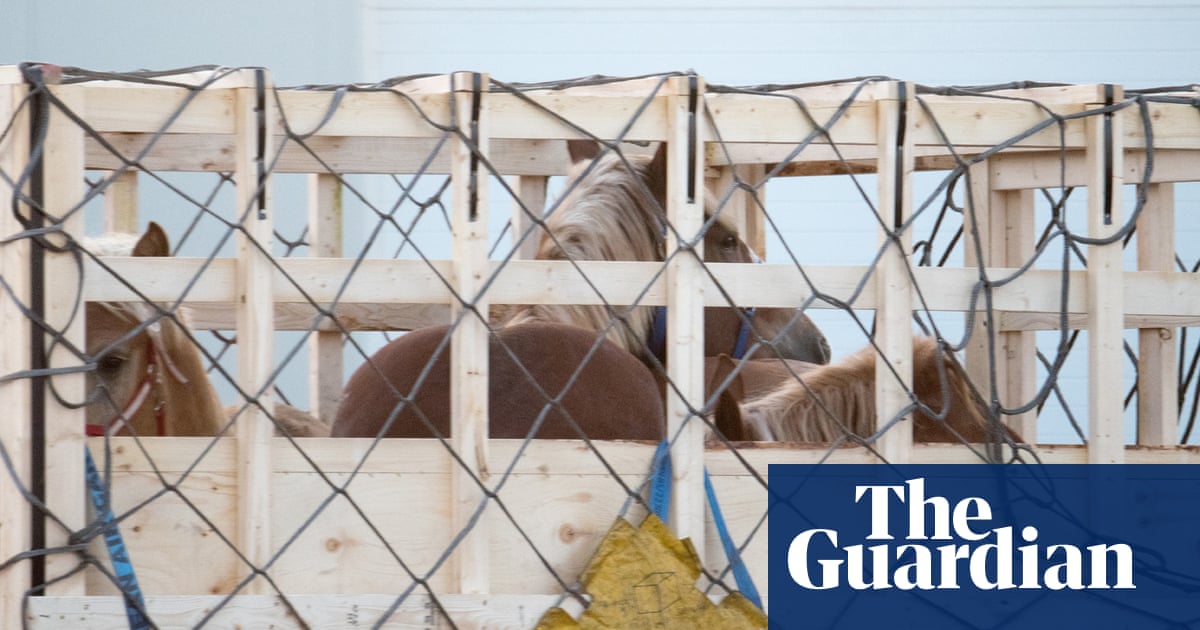
Then because the Canadian Food Inspection Agency turns a blind eye, horses are shipped by air to Japan in flimsy, wooden crates, with as many as possible crammed into each crate.  (Shipping regulations allow for one draft horse per crate, but that regulation is consistently ignored.)


When shipping by air, horses are denied basic nutrition and water, pushing the limit to what the horses can tolerate.  Horses destined for slaughter travel to Japan without the watchful eye of a trained equine specialist.  After all, that would mean an added expense. 


Pictures of horses in a holding pen in Alberta, Canada and destined for slaugher -- are courtesy of Christine Gallant.

*The Canadian Agri-Food Trade Alliance (CAFTA) is a coalition of national and regional organizations that support a more open and fair international trading environment for agriculture and agri-food. CAFTA’s members: Canola Council of Canada, Canadian Cattlemen’s Association, Pulse Canada, Soy Canada, Canadian Pork Council, Canadian Meat Council, Canola Growers Association, Grain Growers of Canada, Cereals Canada, Canadian Sugar Institute, Alberta Cattle Feeders Association, National Cattle Feeders Association, Barley Council of Canada. Based on domestic exports data for 2015, CAFTA’s members account 48 billion dollars of exports, representing 80% of the total value of Canadian agricultural and agri-food products exports.

**In 2012 Canada and Japan announced the launch of negotiations towards a comprehensive and high-level economic partnership agreement (EPA). The  agreement known as the Canada-Japan Economic Partnership seeks to reduce  and in some cases eliminated the non-tariff and tariff barriers that  limits trade between the two nations.

CAFTA seeks expanded market access in Japan through the removal of import tariffs and non-tariff trade barriers.

CAFTA supports Canada’s participation in the EPA and believes it will  significantly contributes to the growth and competitiveness of the  agricultural sector.”

http://cafta.org/trade-agreements/canada-japan-epa/

The following is page 2 of a 1,134 page report – a spread sheet: 

 https://www.international.gc.ca/trade-agreements-accords-commerciaux/assets/pdfs/tpp-ptp/2-D.Japan-Tariff-Elimination-Schedule.PDF (Global Affairs Canada)

“TARIFF SCHEDULE OF JAPAN (HS2012)

(Year 1 – 21 and subsequent years)

LIVE ANIMALS AND ANIMAL PRODUCTS – (NO TARIFFS with exception of 010121.290) 

01.01 Live horses, asses, mules and hinnies 

Horses 

0101.21 Pure-bred breeding animals 

010121.100 Certified as being those other than Thoroughbred,Thoroughbred-grade, Arab, Anglo-Arab or Arab-grade horses (hereinafter referred to as “light-breed horses”) in accordance with the provisions of a cabinet order

2 Other

010121.210(1) “Light-breed horses” certified as being those used for purposes other than horse-race and as being not pregnant in accordance with the provisions of a cabinet order

010121.290(2) Other 3,400,000 yen/each

0101.29 Other

010129.1001 Certified as being not “light-breed horses” in accordance with the provisions of a cabinet order

2 Other 

010129.210(1) “Light-breed horses” certified as being those used for purposes other than horse-race and as being not pregnant in accordance with the provisions of a cabinet order “

T-SHIRTS IN SUPPORT OF HORSE RESCUE FUND 

LIMITED TIME OFFER FREE SHIPPING CANADA & USA 

BAN HORSE SLAUGHTER

FOR HUMAN CONSUMPTION OR ANY PURPOSE
DONATESHOP TO SAVE HORSES

Pin It on Pinterest